

What You Need to Know About Coil Tubing Operator Jobs
Coil tubing operator jobs are one of the most in-demand roles in the oil and gas industry right now, with openings across the US, Middle East, Canada, and Southeast Asia.
Here’s a quick snapshot of what these jobs look like:
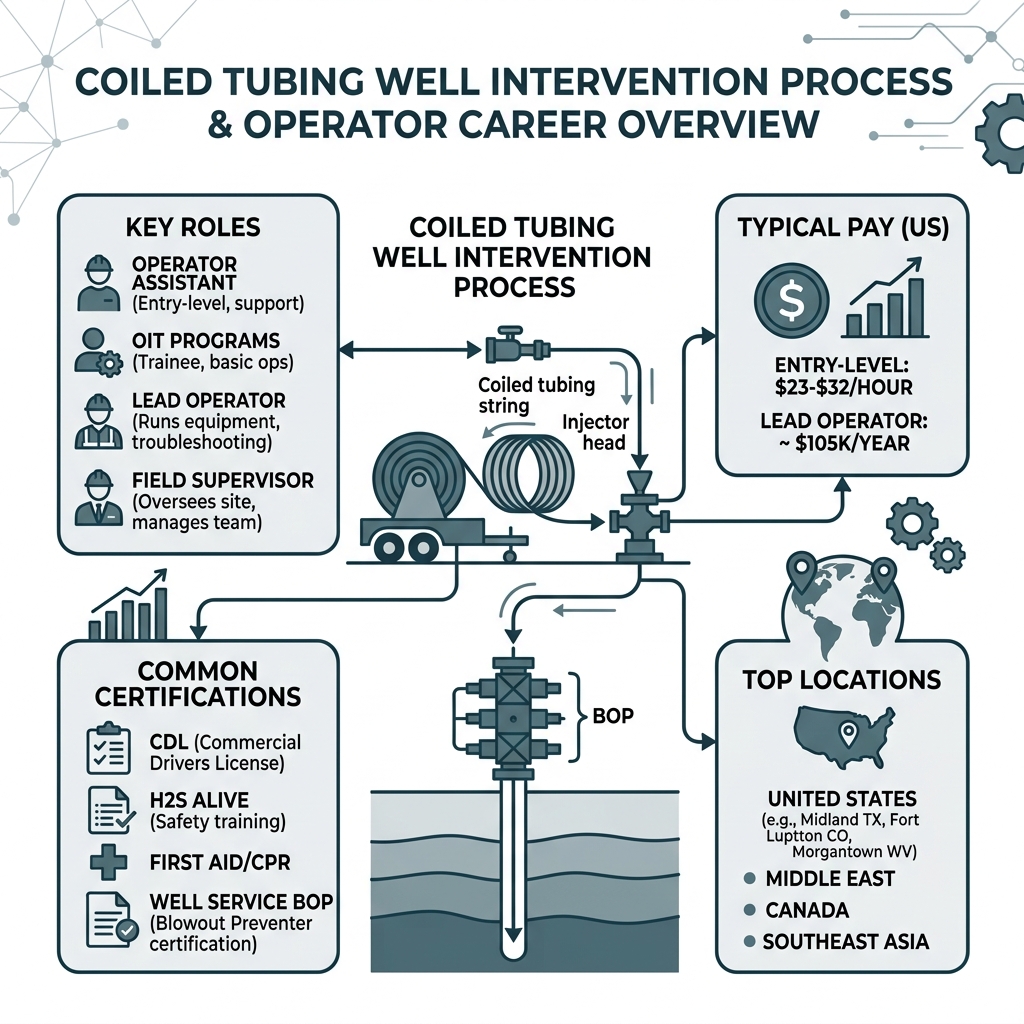
| Factor | Details |
|---|---|
| Entry-level roles available | Yes – Operator Assistant, OIT programs |
| Typical pay (US) | $23-$32/hour (~$105K/year for lead operators) |
| Common schedules | 14/7, 22/13, or 15/6 rotations |
| Key certifications | CDL, H2S Alive, First Aid/CPR, Well Service BOP |
| Top hiring companies | Halliburton, Calfrac, Cudd Energy Services, ADNOC |
| Top US locations | Midland TX, Fort Lupton CO, Morgantown WV |
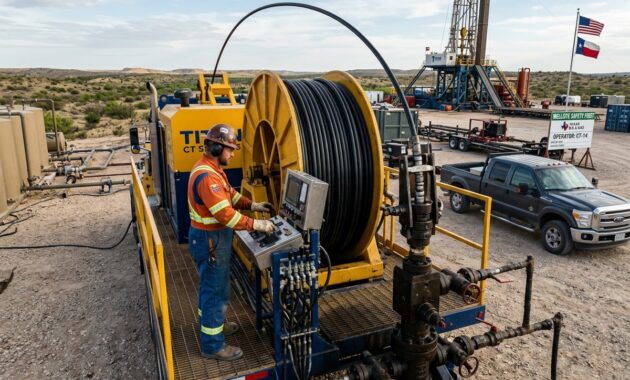
Coiled tubing is a well intervention technique used to perform downhole operations without stopping production. Operators run, maintain, and troubleshoot the heavy equipment that makes this possible – including reel trailers, hydraulic injectors, and control cabins.
It’s physically demanding work done outdoors in all weather. But it also offers stable full-time employment, rotational schedules with real time off, and a clear path from assistant to lead operator to field supervisor.
Whether you’re brand new to the oilfield or looking to level up your career, this guide covers everything you need to know.
Essential Requirements for Coil Tubing Operator Jobs
If you are looking to break into well intervention, you need more than just a strong back. While the physical nature of the job is undeniable, modern coil tubing operator jobs require a specific blend of licensing, education, and technical aptitude. We see many candidates underestimate the paperwork side of the oilfield, but having your “ducks in a row” before applying is the fastest way to get hired.
Driving and Documentation
First and foremost, your driver’s license is your golden ticket. In the United States, a valid Commercial Driver’s License (CDL) Class A is almost always mandatory. Because you’ll be hauling heavy trailers and potentially hazardous materials, employers look for:
- Hazmat and Tanker Endorsements: Essential for transporting the chemicals and fluids used in stimulation.
- Clean Driving Abstract: Most companies require a 3-to-5-year history free of major violations.
- DOT Electronic Logs: You must be comfortable maintaining daily electronic driver logs to stay compliant with federal regulations.
Education and Physicality
A high school diploma or GED is the standard educational baseline. Beyond the diploma, you need to pass a functional physical test. Can you lift 50 pounds repeatedly? Can you work at heights or in confined spaces while wearing a respirator? These are not “maybe” questions—they are daily realities. If you are ready to trade the office chair for a pair of steel-toed boots, check out the latest Oil and Gas Jobs to see which companies are currently prioritizing these qualifications.
High-Demand Regions for Coil Tubing Operator Jobs
The energy map is constantly shifting, but certain “hot spots” remain consistent. In the US, the Permian Basin remains the king of activity. If you are looking for work, Midland, TX and Fort Lupton, CO are currently seeing the highest concentration of job postings. We’ve also noted significant activity in Morgantown, WV, serving the Marcellus Shale.
On the international stage, the Middle East is a massive employer of specialized tubing talent. Locations like Muscat, Oman, Abu Dhabi, and Saudi Arabia frequently seek experienced operators for both onshore and offshore projects. If you are interested in exploring these global hubs, you can find tailored listings for Oil and Gas Jobs in Middle East and specific Oil and Gas Jobs in UAE through our dedicated portals.
Entry-Level Coil Tubing Operator Jobs and Training
Don’t have five years of experience? Don’t sweat it. The industry is currently in a “build from within” phase. Many of the 31+ jobs currently open in the US are listed as Entry Level or Operator Assistant roles.
These positions are essentially “Operator in Training” (OIT) programs. You will start by learning the basics: rigging up iron, mixing fluids, and performing basic equipment maintenance under the watchful eye of a mentor. The best part? Most of these are Rotational Jobs that include paid training. You get your certifications while earning a paycheck, often with the company covering the cost of your safety tickets.
Core Responsibilities in Well Intervention and Maintenance
Once you’re on the clock, the job is a whirlwind of mechanical precision and safety protocols. A typical day starts with a “tailgate” safety meeting before moving into the high-pressure world of “rigging up.”
Rigging Up and Pressure Testing
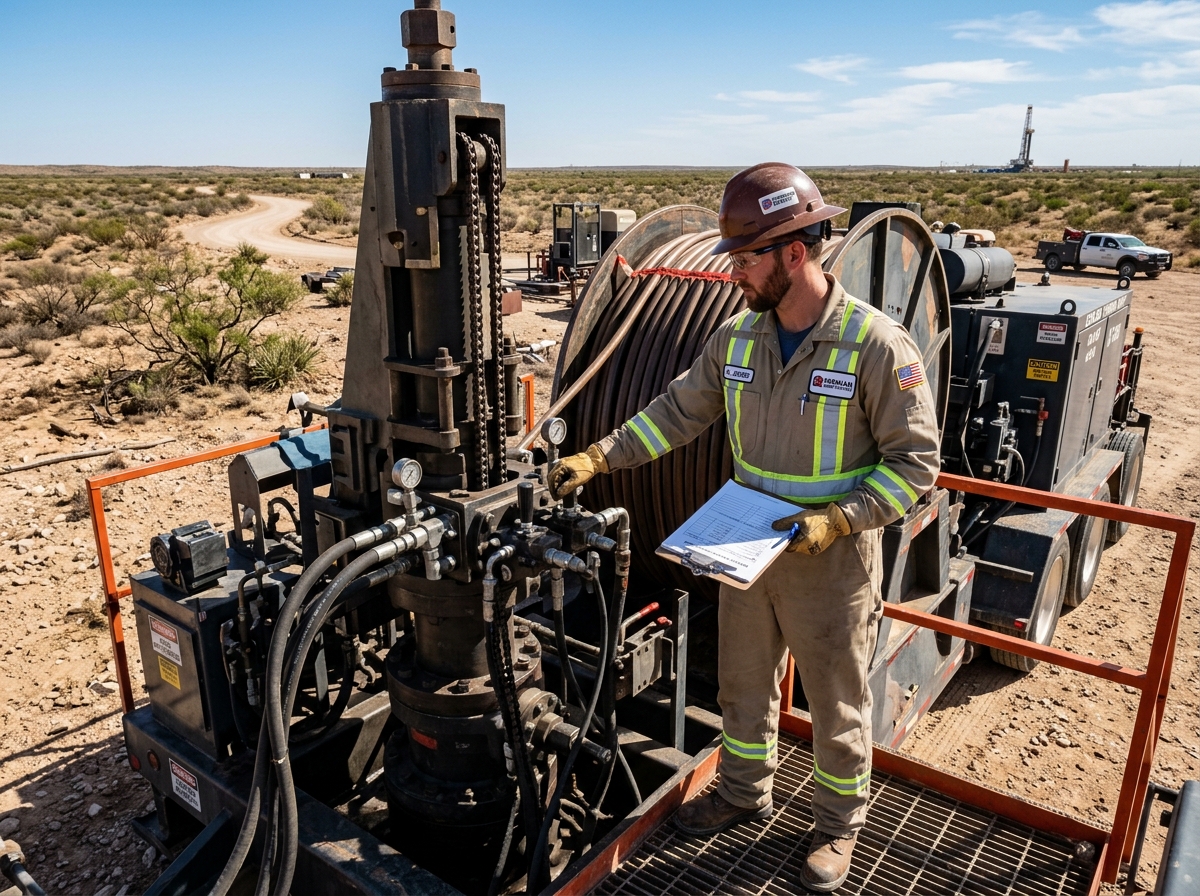
Before the coil ever enters the well, the crew must assemble the pressure control equipment. This involves connecting high-pressure rated pipes (iron) from the pump to the wellhead. We take this seriously because a single loose connection can be catastrophic. Once rigged up, you’ll perform a pressure test to ensure the integrity of the system.
Operating the Reel and Injector
As you progress in coil tubing operator jobs, you eventually move into the control cabin. Here, you use hydraulic controls to manage the injector head—the “muscle” that pushes and pulls the continuous steel tubing into the well. You’ll monitor Data Acquisition Systems (DAS) to track depth, weight, and pressure in real-time.
Fluid Mixing and Stimulation
It’s not just about the pipe; it’s about what goes through it. Operators are responsible for:
- Mixing Chemicals: Preparing acid or specialized gels for well stimulation.
- Nitrogen Stimulation: Using nitrogen to “kick” a well into production by reducing the weight of the fluid column.
- Level 2 Maintenance: This isn’t just “kicking the tires.” It involves pre-trip and post-trip inspections, lubricating the injector, and ensuring the reel is winding correctly.
For those who enjoy the mechanical side of the energy sector, these tasks are also common in Drilling Jobs, where well integrity is the top priority.
Compensation, Rotations, and Career Growth
Let’s talk about the “why”—the paycheck and the lifestyle. Coil tubing operator jobs are known for being lucrative, but they demand a significant time commitment.
Salary Expectations
In the US, a Lead Operator can expect a median annual income of approximately $104,955. Hourly rates typically range from $23 to $32, but the real money comes from overtime and bonuses. Many companies offer “job bonuses” or daily allowances (per diem) that can significantly pad your base pay. For example, some Canadian roles offer meal allowances of up to $50 per day when working out of district.
Rotation Patterns
The oilfield doesn’t follow a 9-to-5 schedule. Instead, you’ll work a rotation. Here is how the most common patterns compare:
| Region | Common Rotation | Days On / Days Off |
|---|---|---|
| USA (Texas/Colorado) | 14 / 7 | 14 days on, 7 days off |
| Canada (Alberta/SK) | 22 / 13 | 22 days on, 13 days off |
| International/Offshore | 28 / 28 or 15 / 6 | Varies by project and location |
These schedules allow for “true” time off where you can leave the job behind completely. To learn more about how these shifts affect your take-home pay, read Everything you need to know about oil rig rotation schedules and pay.
Career Progression
One of the best things about this career path is the lack of a “ceiling.” A typical trajectory looks like this:
- Operator Assistant: Learning the ropes, manual labor, and safety.
- Operator: Running the unit and managing the DAS.
- Lead Operator: Directing the crew during rig-up and rig-down.
- Service Supervisor: Managing the entire job site and client relations.
- Field Service Manager: Overseeing multiple units and logistics across a region.
Safety Standards and Mandatory Certifications
In the oilfield, safety isn’t just a slogan; it’s a requirement for keeping your job. Because you are working with high pressure and potentially sour gas (H2S), certifications are non-negotiable.
Critical Safety Tickets
If you want to be competitive for coil tubing operator jobs, you should aim to collect the following “tickets”:
- H2S Alive: Essential for working in areas where hydrogen sulfide gas may be present.
- Well Service BOP (Blowout Preventer): Training on how to shut in a well during an emergency.
- Standard First Aid & CPR: A baseline requirement for almost every field role.
- ODA (Oilfield Driver Awareness): Specialized defensive driving for heavy equipment.
The Culture of Safety
Expect regular drug and alcohol testing. Most companies have a zero-tolerance policy and conduct pre-employment, random, and post-incident screenings. Every day begins with a “toolbox talk” to identify hazards. If you are looking at Offshore Jobs, these safety requirements become even more stringent, often including helicopter underwater escape training (HUET).
Frequently Asked Questions about Coiled Tubing Roles
What are the primary physical demands of the job?
Working in coil tubing operator jobs means being prepared for the elements. You will work 12-hour shifts (day or night) in extreme heat, freezing cold, or pouring rain. You must be able to stand for long periods, climb ladders on the unit, and lift heavy iron components weighing up to 50 pounds.
What should I include in my coiled tubing resume?
Employers like Cudd Energy Services or Halliburton look for specific details. We recommend including:
- A 10-year work history with no unexplained gaps.
- Detailed CDL information, including endorsements and your medical card status.
- A list of all current safety tickets and their expiration dates.
- Specific mention of mechanical aptitude (e.g., experience with hydraulics or diesel engines).
Are there international opportunities for experienced operators?
Absolutely. The demand for skilled operators in Malaysia, Qatar, and Saudi Arabia is high. These roles often offer lucrative tax-free salaries and “business class” rotations. If you have a few years of experience under your belt, check out Oil and Gas Jobs in Malaysia for a change of scenery.
Conclusion
At Elite Innovation LLC, we understand that finding the right fit in the energy sector can feel like trying to untangle a “bird’s nest” of cable. But with the right certifications and a solid understanding of the rotational lifestyle, coil tubing operator jobs offer a path to financial stability and rapid career progression.
The industry is currently seeing a surge in well intervention needs as older wells require maintenance to stay productive. This means job security for those with the technical expertise to handle the reel. Whether you are aiming for a role in the Permian Basin or looking at Oil and Gas Jobs in Qatar, the opportunities are there for the taking. Keep your boots clean, your CDL current, and your safety tickets updated—the oilfield is waiting for you.