
Why Construction Jobs General Labor Are One of the Best Ways to Start a Trades Career
Construction jobs general labor are one of the most accessible entry points into the building industry — no degree required, and many roles offer on-the-job training from day one.
Here’s a quick look at what you need to know for 2026:
| Topic | Quick Answer |
|---|---|
| Experience needed | None to 1+ years (many roles train on the job) |
| Typical pay | $20 – $25/hour, with overtime available |
| Common tasks | Site prep, tool operation, material handling, concrete work |
| Job growth | Up to 10% growth expected in construction occupations |
| Where to find jobs | Staffing agencies, job boards, union halls, direct applications |
Whether you want steady weekly pay, physical work you can feel proud of, or a stepping stone into a skilled trade, general labor in construction delivers all three.
The demand is real. The construction industry is projected to grow as much as 10% through 2026 and beyond, meaning companies are actively hiring — right now — across residential, commercial, and industrial projects.
And the barrier to entry is lower than most people think.
Many positions listed on government job boards and with major staffing agencies require zero formal education or prior experience. You show up ready to work, and the training happens on site.
This guide walks you through everything — from what the job actually looks like day-to-day, to how much you can earn, to where you can go from here.
Simple construction jobs general labor word guide:
Understanding Construction Jobs General Labor Roles
When we talk about construction jobs general labor, we are talking about the backbone of every building site. Without general laborers, specialized trades like electricians or plumbers wouldn’t have a clean, safe, or prepared environment to work in. These roles are incredibly diverse, covering residential, commercial, and massive industrial infrastructure projects.

In these roles, we focus heavily on site preparation. This means arriving early to set up safety perimeters, unloading the morning’s delivery of lumber or steel, and ensuring that all tools are laid out and ready for the day’s tasks. We also handle the “heavy lifting” of site maintenance—removing debris, cleaning up spills, and organizing materials so that the site remains efficient and hazard-free. For those looking for a deeper dive into the industry, you can find more info about civil and construction jobs to see how these roles fit into the bigger picture.
Daily Responsibilities and Tasks
A day in the life of a general laborer is rarely boring. Depending on the project, we might find ourselves assisting with concrete finishing—using tools like screeds and floats to smooth out a fresh pour for a new sidewalk or floor. On other days, the focus might shift to trench digging for utility lines or the assembly and disassembly of scaffolding.
Common daily tasks include:
- Material Handling: Loading and unloading construction supplies from trucks and moving them to where they are needed.
- Site Preparation: Clearing rubble, digging holes, and leveling earth using shovels and rakes.
- Tool Operation: Using both hand tools (hammers, saws) and power tools (impact drivers, circular saws) under supervision.
- Assisting Craftsmen: Helping form carpenters set up wooden frames or assisting pump operators during a concrete pour.
The Physical Demands and Work Environment
Let’s be honest: this is a tough job. We work in extreme weather conditions, whether it’s the heat of a New York summer or the humidity of a site in Malaysia or Qatar. You need excellent stamina and the ability to lift heavy materials—often up to 50 lbs or more—repeatedly throughout an eight-hour shift.
Manual dexterity and a good sense of balance are also vital, especially when working near moving machinery or on elevated platforms. If you are wondering how to prepare for this, check out our guide on how to land general labor jobs without breaking a sweat.
Requirements for Entry-Level Success
One of the best things about construction jobs general labor is that the door is wide open for those willing to work hard. While some specialized roles require years of schooling, many general labor positions prioritize your work ethic over your resume.
| Feature | Entry-Level Laborer | Skilled Tradesperson |
|---|---|---|
| Education | High School Diploma/GED | Trade School/Apprenticeship |
| Experience | 0 – 1 Year | 3 – 5+ Years |
| Training | On-the-job | Formal Certification |
| Focus | Site prep, cleanup, assistance | Specialized installation/repair |
Many employers provide comprehensive on-the-job training. While a high school diploma is usually preferred, your ability to follow instructions and show up on time is often more valuable. For those looking to get a head start, organizations like the Associated Builders & Contractors offer resources and local chapters to help new workers find their footing.
Entry-Level Construction Jobs General Labor Opportunities
There are several ways to get your foot in the door. Seasonal work is a huge market; many companies hire extra hands for the peak building months between April and November. These roles are fantastic for building a portfolio of experience.
We see opportunities in:
- Residential Projects: Building homes, apartments, and townhouses.
- Commercial Developments: Working on offices, retail spaces, and hospitals.
- Infrastructure Builds: Contributing to roads, bridges, and municipal water projects.
- Temporary Labor: Short-term contracts that allow you to see different types of jobsites.
Essential Skills and Qualifications
Beyond physical strength, we look for “soft skills” that make a jobsite run smoothly. Reliability and punctuality are non-negotiable—if you aren’t there at 7:00 AM, the whole team is slowed down. Communication is also key; you need to be able to report hazards to your foreman and coordinate with your teammates.
Problem-solving is another big one. Sometimes a tool breaks or a delivery is late, and we need laborers who can adapt and find a way to keep the project moving. Finally, obtaining an OSHA 10 certification is a major plus. It shows employers you understand basic safety protocols and are serious about your career.
Compensation and Career Growth Paths
The pay for construction jobs general labor is quite competitive compared to other entry-level industries. Based on recent market data, we see hourly rates ranging from $20.53 to $24.89.
But the base pay is just the start. Many of these roles offer:
- Overtime Pay: Often at 1.5x your hourly rate for hours worked over 40.
- Seasonal Bonuses: Extra pay for completing a project on time or staying through the end of the season.
- Benefits Packages: Many established firms offer health, dental, and vision insurance, along with 401(k) retirement plans with company matching.
The long-term outlook is even better. According to the Bureau of Labor Statistics, construction occupations are expected to grow as much as 10% through 2033.
Finding Construction Jobs General Labor Near You
Finding work is easier than ever if you know where to look. Staffing agencies are a great resource, as they often have thousands of open positions and can match you with a project that fits your skill level. Online job boards and platforms like LinkedIn are also active, especially in major hubs like New York, Karachi, and the Middle East.
Don’t forget local networking. Sometimes the best way to find a job is to head to a local union hall or check with companies directly. For those interested in specific niches, you can find more info about electrical helper labor jobs to see if that path interests you.
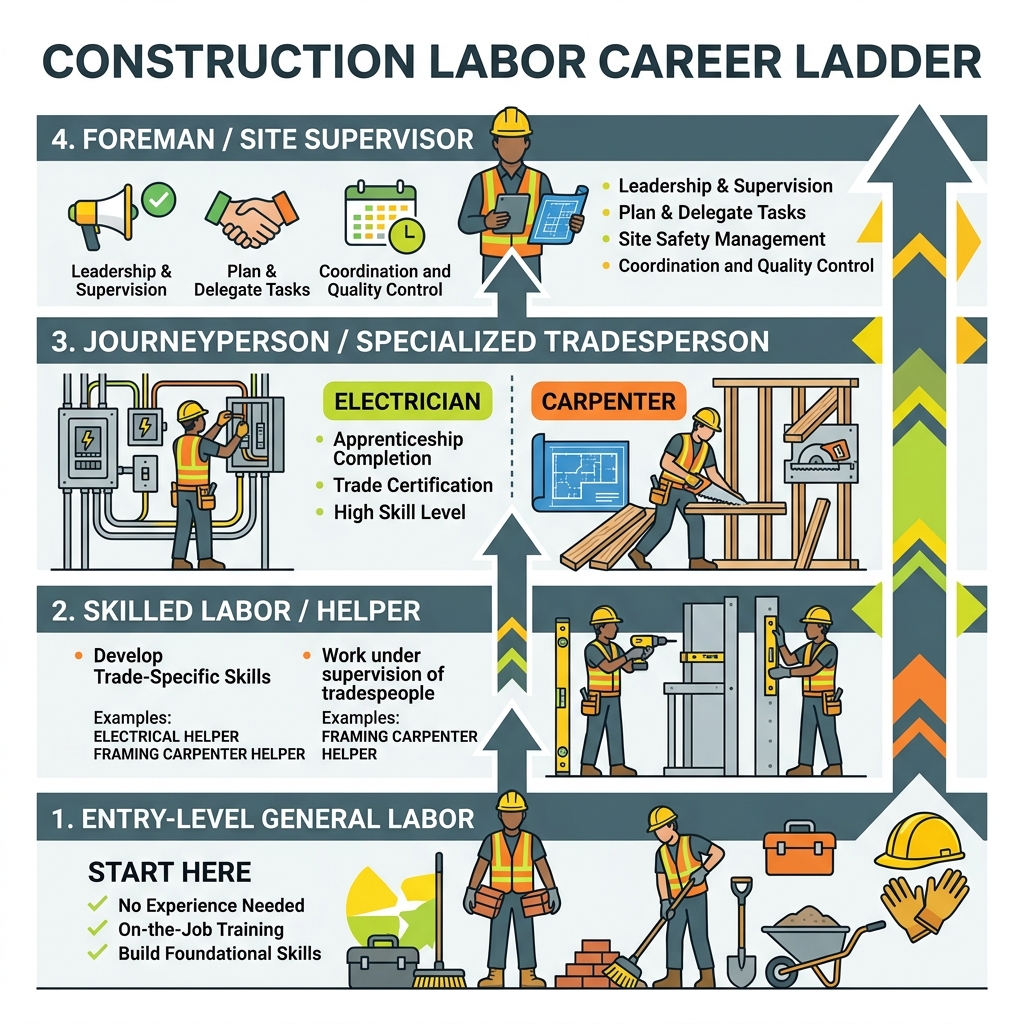
Advancing to Specialized Trades
General labor is not just a job; it’s a classroom. While you are cleaning sites and hauling lumber, you are watching the carpenters, electricians, and heavy equipment operators work. Many laborers use this exposure to decide which trade they want to pursue.
Common advancement paths include:
- Carpentry: Moving from a helper to a framing or finish carpenter.
- Electrical/Plumbing: Transitioning into an apprenticeship program.
- Heavy Equipment: Training to operate bulldozers, excavators, or cranes.
- Supervision: Moving up to a Lead Laborer or Foreman position.
If you’re interested in the woodworking side of things, check out our guide to framing carpenter helper jobs
Safety Practices and Site Training
Safety is the number one priority on any construction site. We operate under strict guidelines, including MSHA and OSHA rules, to ensure everyone goes home healthy at the end of the day.
Every day begins with safety checks. This includes inspecting the work area for hazards like loose wires or unstable ground and conducting a Job Safety Analysis (JSA). We emphasize the “Speak Up” culture—if you see something unsafe, you have the authority and the responsibility to stop work and report it to a supervisor.
Key safety practices include:
- Proper PPE: Always wearing your hard hat, steel-toed boots, and high-visibility gear.
- Hazard Elimination: Securing the site daily and properly disposing of waste materials.
- Tool Safety: Only operating machinery you have been trained on.
Organizations like the Associated General Contractors of America provide excellent frameworks for these safety standards.
Frequently Asked Questions about General Labor
Do I need prior experience for general labor?
No! While having a year of experience can help you land a job faster, many companies are happy to hire entry-level workers with a strong work ethic. They provide on-the-job training and mentorship to help you develop the necessary skills.
What is the average pay for a construction laborer?
The average pay generally falls in the $20 to $25 per hour range. This can vary based on your location—for example, rates in New York might be higher than in rural areas—and whether the job is a specialized seasonal role. Overtime opportunities can significantly increase your take-home pay.
What are the most common tools used?
As a general laborer, you’ll get familiar with a wide variety of tools. You’ll likely use impact drivers and circular saws for basic assembly, tape measures for layout work, and hand floats or screeds for concrete finishing. Learning to use these accurately and safely is a major part of your early training.
Conclusion
At Elite Innovation LLC, we know that the construction industry offers a world of opportunity for those ready to roll up their sleeves. Whether you are in Muscat, New York, or Riyadh, the demand for construction jobs general labor is stronger than ever. The job market is growing, the pay is competitive, and the career paths are endless.
If you’re ready to build your future, there’s no better time to start. Take that first step, get your safety gear ready, and join a team that’s building the world around us.
Ready to start your search? Apply for construction and industrial jobs today and find the role that’s right for you!