

Why Thousands of Workers Are Chasing Health and Safety Jobs in Oil and Gas Industry Right Now
Health and safety jobs in the oil and gas industry are among the most in-demand roles in the energy sector right now — and the numbers back that up.
Here’s a quick snapshot of what’s available today (April 2026):
| Platform | Active Listings |
|---|---|
| LinkedIn (US Oilfield Safety) | 7,000+ jobs |
| Rigzone (Global Safety) | 1,078 jobs |
| New US postings (past month) | 7,823 |
| New US postings (past week) | 2,839 |
Top hiring locations:
- Houston, TX (29 jobs)
- Aberdeen, Scotland (25 jobs)
- Mumbai, India (25 jobs)
- Saudi Arabia (11 jobs)
Experience levels in demand:
- 0–4 years experience: 647 jobs available
- 5–9 years experience: 203 jobs available
This is a market that rewards both newcomers and seasoned professionals.
Oil and gas sites — from drilling rigs to refineries — run 24/7 in high-risk conditions. That means companies constantly need qualified people to keep workers safe, stay compliant with regulations, and prevent costly incidents. It’s stable, essential work that doesn’t disappear when the economy slows down.
Whether you’re just starting out or looking to move up, knowing how to find and land these roles makes all the difference. Below, you’ll find 10 smart, practical ways to do exactly that.
Essential Roles in the Health and Safety Jobs in Oil and Gas Industry
Before we dive into the “how,” we need to understand the “what.” The health and safety jobs in oil and gas industry aren’t just about wearing a hard hat and carrying a clipboard. These roles are the backbone of operational integrity.
An HSE (Health, Safety, and Environment) Manager, for instance, is a leadership powerhouse. They don’t just watch for trips and falls; they direct plant-wide safety programs to maintain low accident rates and ensure the company stays on the right side of local and federal laws. In a refinery setting, this might involve supervising up to seven direct reports and managing community relations with local residents.
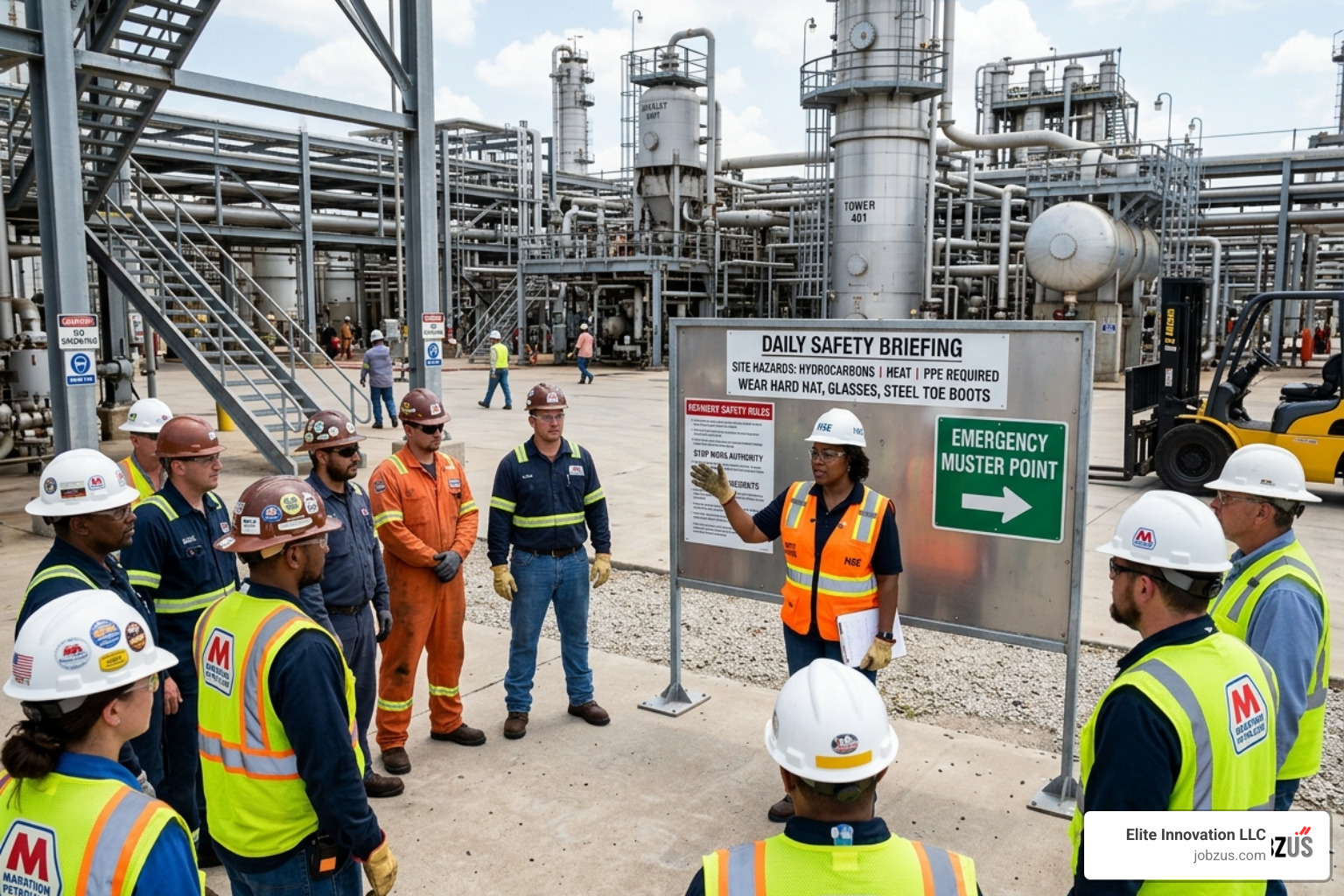
Other critical roles include the Safety Supervisor, who is the “boots on the ground” ensuring that daily activities follow the rules, and the Process Safety Manager, who focuses on preventing catastrophic releases of hazardous materials. Whether you are interested in Category Health Safety and Environment or specialized incident management, the industry requires a mix of regulatory knowledge and hands-on risk assessment.
1. Target High-Impact HSE Engineering Positions
If you have a background in engineering or a heavy technical interest, the HSE Engineer role is a fantastic entry point. These professionals are the architects of safety. Their primary mission is to ensure that oil and gas operations comply with strict regulations while minimizing environmental footprints.
As an HSE Engineer, your day might involve:
- Pollution Prevention: Developing strategies to handle waste management and air emissions.
- Internal Audits: Checking site compliance against international standards like ISO 45001.
- Risk Mitigation: Designing systems that prevent accidents before they happen.
To succeed here, we recommend checking out these 10 Dos and Donts for HSE Jobs in Oil and Gas to ensure your resume highlights the right technical strengths.
2. Pursue Specialized Process Safety Management (PSM)
Process Safety Management is where the “heavy lifting” of safety happens. Unlike occupational safety (slips and falls), PSM is about the big stuff—fires, explosions, and toxic releases.
Companies are looking for specialists who understand the MOC (Management of Change) process. When a refinery changes a piece of equipment or a software setting, a PSM expert must identify the new hazards introduced. If you are looking at a Sr Health and Safety Specialist/Process Safety Management role, expect to spend 35% to 55% of your time traveling to different assets to ensure SOP (Standard Operating Procedure) development is consistent across the board.
3. Explore Lead Operational Advisor Opportunities
For those who enjoy the thrill of the field combined with high-level consulting, becoming a Lead Operational Safety Advisor is a great move. These roles often bridge the gap between office-based planning and site-based execution.
Key responsibilities in this niche include:
- Accident Investigation: Using Root Cause Analysis to figure out why something went wrong and how to fix it permanently.
- SIMOPS Dossiers: Managing “Simultaneous Operations,” where drilling, construction, and production are happening in the same space at the same time.
- Behavioral Safety: Implementing programs that encourage workers to watch out for one another.
If you are a contractor or looking for project-based work, there is a high demand for Project Safety QA QC Construction Site Engineers who can jump into active builds and ensure safety from day one.
Top Geographic Hotspots and Market Statistics for 2026
Where you look is just as important as how you look. As of April 2026, the market is split between massive domestic demand in the US and high-paying international hubs.
| Region | Active Job Openings (Approx.) | Top Locations |
|---|---|---|
| United States | 7,000+ | Houston, Midland, Odessa |
| Middle East | 500+ | Saudi Arabia, Oman, Qatar |
| North Sea / Europe | 300+ | Aberdeen, Stavanger |
While Houston remains the global capital for energy, we are seeing a massive surge in Oil Gas HSE Jobs in the Middle East, particularly for those willing to relocate to Saudi Arabia or Oman.
4. Focus on the United States Gulf Coast and Permian Basin
If you want to stay in the USA, the Permian Basin (Midland and Odessa, TX) is the place to be. There are currently over 7,800 monthly postings for oilfield safety roles in the US, and a huge chunk of those are concentrated in the Texas and Louisiana regions.
Refinery safety is a major sub-sector here. Roles like the Safety and Risk Manager often require at least 10 years of experience in manufacturing environments. These positions are high-stakes but offer excellent stability and benefits. You can browse the latest openings in our Category Oil and Gas HSE Jobs section to see what’s currently popping up in the Gulf.
5. Leverage Opportunities in the Middle East and North Sea
For those looking for an international adventure, the Middle East and the North Sea offer unique challenges. In the North Sea (Aberdeen), you’ll need to be well-versed in UKCS Regulations and likely hold an Offshore Survival Certificate (BOSIET) and a valid OEUK Medical.
In the Middle East, specifically Oman and Saudi Arabia, the demand for HSE professionals is soaring. You can find hundreds of hse Jobs in Oman that offer competitive, often tax-free packages. Senior roles, such as a Senior HSE Advisor, involve acting as the focal point for both onshore and offshore activities, supporting ISO 45001 systems and driving safety campaigns.
Must-Have Certifications and Technical Skills for HSE Success
You wouldn’t go onto a rig without boots, and you shouldn’t go into the job market without the right credentials. In 2026, the “gold standard” remains the NEBOSH Diploma or International Certificate.
Other essential certifications include:
- CSP (Certified Safety Professional): Highly valued in the US for management roles.
- OSHA 30: A baseline requirement for many field safety positions.
- ISPON Level 3: Frequently required for roles in specific regions like Nigeria or parts of the Middle East.
- Professional Engineer (PE) or CIH (Certified Industrial Hygienist): Often preferred for Senior Project QA QC HSE Engineers in Saudi Arabia.
6. Master Technical Risk Identification Tools
The industry has moved beyond simple checklists. To land a top-tier health and safety job in oil and gas industry, you need to be familiar with the “alphabet soup” of risk assessment tools.
Employers want to see that you can lead or participate in:
- HAZOP (Hazard and Operability Study): Identifying risks in process systems.
- LOPA (Layer of Protection Analysis): Evaluating if you have enough “barriers” to stop an accident.
- HEMP (Hazards and Effects Management Process): A core tool used by major operators.
- ALARP Principle: Demonstrating that risks are “As Low As Reasonably Practicable.”
If you can speak fluently about these tools in an interview, you’ll immediately stand out. Check the Lead Operational Safety Advisor job descriptions to see how these tools are applied in real-world scenarios.
7. Finding Health and Safety Jobs in Oil and Gas Industry via Specialized Boards
Generic job boards like Indeed are okay, but specialized platforms are where the high-quality energy roles live.
- Rigzone: The industry leader for offshore and drilling roles. If you are looking for Safety Jobs in Qatar, this is your best bet.
- LinkedIn: Use the “Alerts” feature for keywords like “Oilfield Safety” or “HSE Manager.”
- Naukrigulf & Careerjet: Excellent for finding vacancies in Oman, Saudi Arabia, and the wider Middle East.
- Jobzus: We curate a specific Category Oil Gas HSE Jobs list that filters out the noise and focuses on the energy sector.
8. Highlight Experience with High-Risk Environments
If you’ve spent time on a drilling site or in a refinery, shout it from the rooftops! Experience in high-risk environments is the most valuable currency in this industry.
Companies like Oilserv Group look for HSE Officers who can manage PPE compliance, lead emergency drills, and oversee radiation safety protocols. Mentioning your hands-on experience with “Permit to Work” (PTW) systems and daily toolbox meetings will show recruiters that you are ready to hit the ground running.
Strategic Platforms and Career Growth
One of the best things about health and safety jobs in oil and gas industry is the clear path for advancement. You don’t have to stay a technician forever.
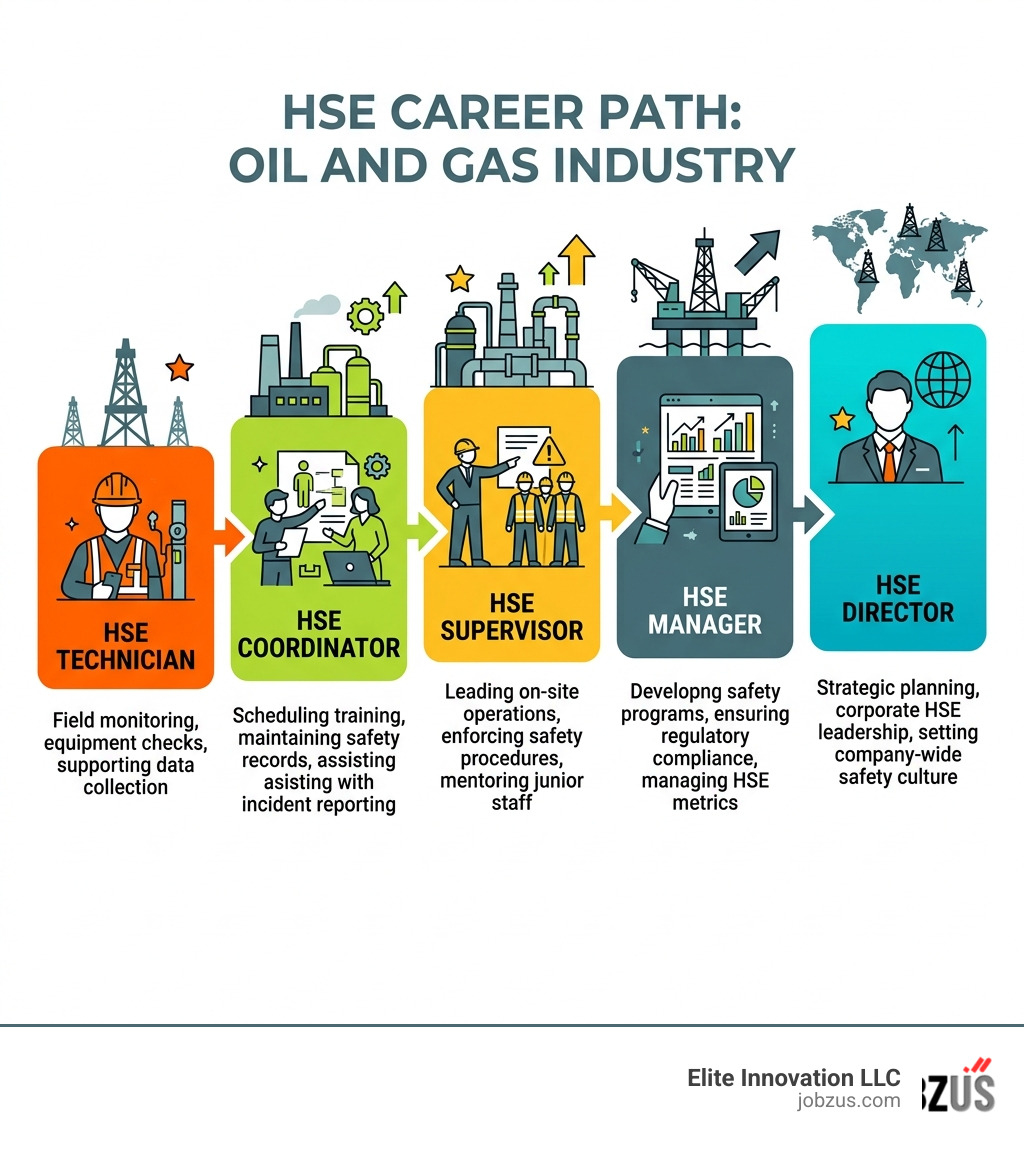
Many professionals start as an HSE Technician (0-4 years experience), move into an HSE Coordinator role, and eventually become a Director. Along the way, you might specialize in Electrical Lead HSSE Project Construction or move into QA/QC roles.
Salaries for senior roles often exceed $100,000, especially when performance bonuses and offshore uplifts are included. Even entry-level roles are competitive, with many starting in the $40,000 to $60,000 range depending on the location and specific site hazards.
9. Career Progression in Health and Safety Jobs in Oil and Gas Industry
Progression isn’t just about a title change; it’s about increasing your scope of influence.
- HSE Technician/Officer: Focuses on site compliance and daily reporting.
- HSE Engineer/Specialist: Focuses on technical systems, audits, and design.
- HSE Manager: Focuses on policy, budgeting, and team leadership.
- HSE Director: Focuses on global strategy and corporate sustainability.
As you move up, mentoring trainees becomes a key part of the job. You’ll be the one training the next generation of Lead Operation Instrument Construction HSE Pipeline Engineers.
10. Adapt to the Energy Transition and Renewables
The world is changing, and the energy industry is changing with it. The “Energy Transition” means that the skills you learn in oil and gas safety are now highly transferable to:
- Wind Energy: High-altitude safety and offshore logistics.
- Nuclear Safety: High-stakes process safety and radiation management.
- Sustainability Reporting: Managing carbon footprints and ESG (Environmental, Social, and Governance) goals.
If you are a Project Safety Engineer, your knowledge of risk management is a “universal language” that will keep you employed for decades, regardless of the fuel source.
Frequently Asked Questions
What are the primary responsibilities of an HSE Engineer in oil and gas?
The primary role is to ensure operations comply with safety and environmental regulations. This includes conducting risk assessments, organizing safety training, maintaining compliance records, performing internal audits, and coordinating incident investigations to prevent future occurrences.
Which certifications are most valuable for oil and gas safety roles in 2026?
The most sought-after certifications include the NEBOSH International Diploma, Certified Safety Professional (CSP), OSHA 30-Hour, and BOSIET (for offshore roles). In specific regions, the ISPON Level 3 is also critical.
What is the current salary outlook for HSE Managers in the industry?
The outlook is very strong. Senior HSE Managers can expect salaries of $100,000 to $150,000+, often supplemented by performance bonuses, pension schemes, and comprehensive health insurance. Even mid-level roles (5-9 years experience) often see salaries in the $80,000+ range in major hubs like Houston or the Middle East.
Conclusion
Finding the right health and safety jobs in oil and gas industry requires a blend of the right certifications, a strategic search on specialized job boards, and a willingness to work in high-stakes environments. From the refineries of Texas to the offshore platforms of the North Sea, the opportunities are vast for those who prioritize the well-being of their colleagues.
At Elite Innovation LLC, we believe that a safe workplace is the foundation of a successful business. Whether you are an entry-level technician or a seasoned director, the path to your next great role is open.
Ready to take the next step in your career?
Discover our current jobs in Oil & Gas HSE and join a global community of experts dedicated to making the energy industry safer for everyone.
