


Manufacturing Engineer Graduate Jobs: What You Need to Know in 2026
Manufacturing engineer graduate jobs are in high demand right now, with over 3,000 entry-level openings actively listed across the United States at any given time.
If you want a quick answer, here are the top options available to new grads:
| Job Title | Typical Starting Salary | Key Industry |
|---|---|---|
| Manufacturing Engineer (New Grad) | $78,000 – $110,000/yr | Aerospace, Automotive |
| Production Engineering Specialist | $30 – $40/hr (CAD) | Industrial Equipment |
| Industrial/Process Engineer | $60,000 – $90,000/yr | Semiconductor, Defense |
| Manufacturing Management Program | Competitive + benefits | General Manufacturing |
- Top hiring companies include Honeywell, Procter & Gamble, Lockheed Martin, Applied Materials, and Divergent
- Most roles are full-time and on-site (not remote)
- Degrees in Mechanical, Industrial, or Aerospace Engineering are most in demand
- Key skills employers want: CAD software, Lean Manufacturing, Six Sigma, and hands-on internship experience
The job market for new grads entering manufacturing is genuinely strong. Hundreds of new positions are posted every single week. Companies across aerospace, semiconductors, and automotive are actively building out structured graduate programs — not just filling seats, but investing in early-career engineers for the long term.
Whether you’re finishing your degree or just graduated, this is a good time to be looking.
Below, we break down the best industries, companies, salaries, and application strategies to help you land the right role fast.
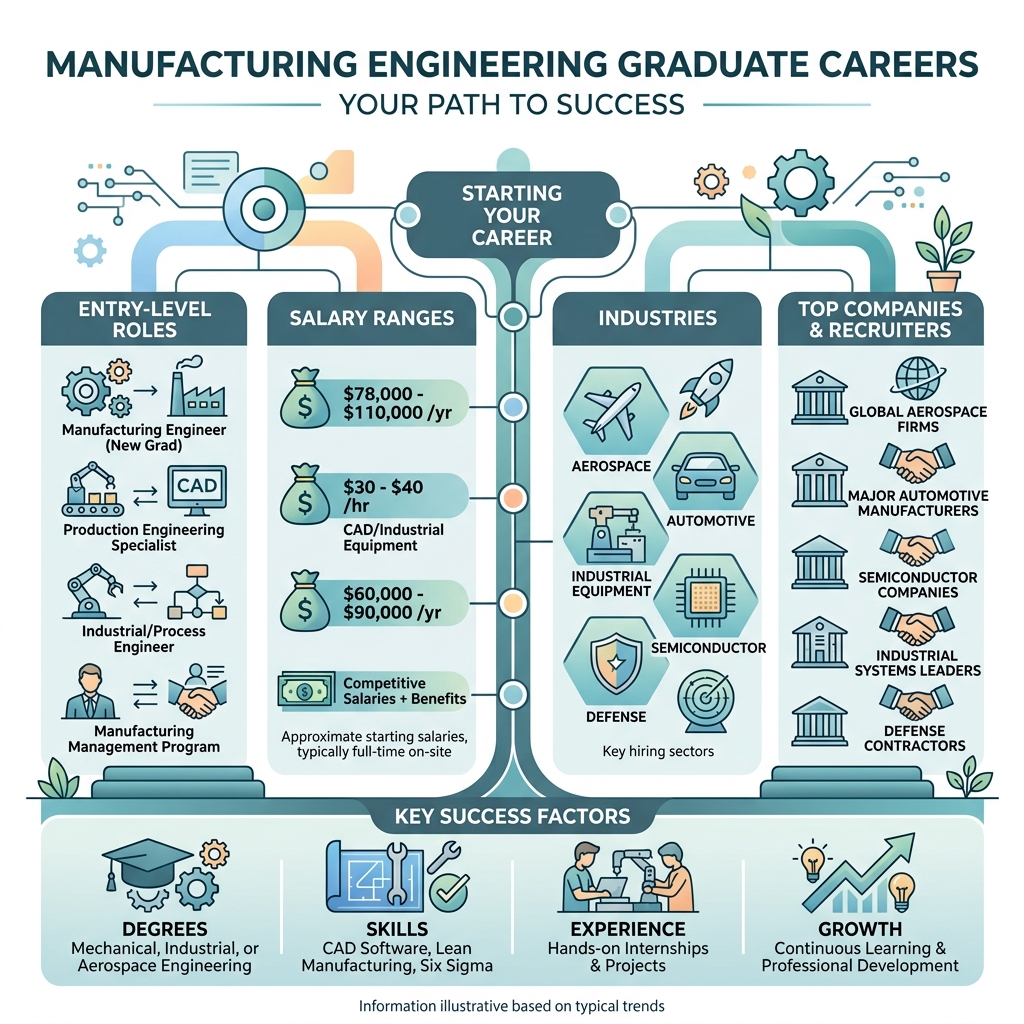
Simple manufacturing engineer graduate jobs glossary:
Top Industries and Companies for Manufacturing Engineer Graduate Jobs

The landscape for manufacturing engineer graduate jobs is incredibly diverse, spanning from the microscopic world of semiconductors to the massive scale of aerospace assembly. If you are looking for where the most opportunities live, you have to look at the sectors currently undergoing massive technological shifts.
Semiconductor Industry
The semiconductor industry is a massive employer of new grads. Companies like Applied Materials are at the forefront, offering specialized tracks for those finishing their degrees. In this sector, manufacturing engineers focus on transforming complex designs into physical products through highly controlled, automated processes. It’s a high-stakes environment where precision is everything.
Aerospace and Defense Sector
Aerospace is currently a “hot” zone for entry-level talent. Major players like Honeywell and Lockheed Martin are frequently hiring. These roles often involve working on high-reliability hardware, where you might be optimizing the production of jet engines or satellite components. For those interested in this path, many companies offer sign-on bonuses and multiple shift options to accommodate a growing workforce.
Automotive Innovation
The automotive world isn’t just about assembly lines anymore; it’s about digital workflows and advanced factory systems. Companies are looking for engineers who can handle rapid iteration and support prototype builds. If you’ve ever wondered where do industrial engineering grads actually work anyway, the answer is increasingly in these high-tech automotive environments where machine learning and automation meet physical hardware.
Rotational Programs and Manufacturing Engineer Graduate Jobs
If you aren’t sure exactly which part of a factory you want to call home, rotational programs are your best friend. These are structured “fast-track” initiatives designed to turn a fresh graduate into a well-rounded leader.
- Engineering Rotational Programs: These typically last 1-2 years and move you through different departments like quality, production, and design.
- Field Service Engineering: Some programs, like those at Applied Materials, focus on the “customer side,” where you learn to install and maintain complex machinery globally.
- Accelerated Development: Programs like the “Accelerated Engineer” track focus on rapid skill acquisition, often including mentorship from senior executives.
- Manufacturing Management Programs: Some companies offer tracks specifically for those who want to move into leadership, combining technical engineering with supply chain and people management.
High-Tech Automotive and Defense Roles
In the modern market, some of the most exciting manufacturing engineer graduate jobs are found with Tier 1 suppliers and tech-heavy startups. These companies are reinventing the factory itself.
For example, companies like Divergent are using the “DAPS” (Divergent Adaptive Production System) technology, which utilizes additive manufacturing (3D printing) and automated assembly to build vehicle structures. As a new grad here, you wouldn’t just be watching a machine; you’d be implementing digital workflows and using data-driven initiatives to improve “first-pass quality”—which is fancy engineering speak for “getting it right the first time.”
Essential Qualifications and Skills for New Grads
To land one of these roles, you need more than just a degree—you need the right degree and a specific set of tools in your professional belt.
Educational Foundation
Most employers require a Bachelor’s degree from an ABET-accredited institution. The most common majors they look for include:
- Mechanical Engineering
- Industrial Engineering
- Aerospace Engineering
- Manufacturing Engineering
While a 3.0 GPA is often the “gatekeeper” minimum, many top-tier firms prefer a 3.2 or higher. If you are coming from a slightly different background, like industrial design, you might find that while your skills are creative, you’ll need to bridge the gap into technical production. If so you graduated in industrial design and now you need a job, focusing on the “manufacturability” aspect of your designs is the best way to pivot into these roles.
Technical Skills for Manufacturing Engineer Graduate Jobs
Beyond the degree, employers are scanning resumes for these specific keywords:
- CAD Proficiency: Whether it’s SolidWorks, AutoCAD, or CATIA, you need to be able to read and create technical drawings.
- Lean Manufacturing & Six Sigma: Understanding how to eliminate waste and reduce variation in a process is non-negotiable in modern manufacturing.
- Design for Manufacturability (DFM): This is the ability to look at a cool design and say, “Here is how we can actually build this without it costing a fortune.”
- Process Simulation: Using software to model a production line before it’s even built.
- Robotics & Automation: Familiarity with PLC programming or robotic arm integration is a massive plus.
- Troubleshooting: The ability to look at a broken process and find the root cause using data, not just guesswork.
Salary Expectations and Compensation Packages
Let’s talk about the part everyone cares about: the paycheck. Manufacturing engineer graduate jobs are among the better-paying entry-level roles in the engineering world.
Typical Pay Ranges
Based on current market data, here is what you can expect:
- Honeywell: Recent grad positions typically offer a base pay range of $78,000 to $102,500 per year.
- Divergent: New grad roles in high-tech hubs like California can range from $100,000 to $110,000.
- Siemens (Canada): Production Engineering Specialists often start at an hourly rate of $30.00 to $40.00 CAD.
The Full Package
It’s not just about the base salary. Most major manufacturing firms offer comprehensive packages that include:
- Sign-on Bonuses: Common in the aerospace and defense sectors to attract top talent.
- Relocation Assistance: If the job is in a different state, many companies will pay for your move.
- 401(k) Matching: A standard way to start your retirement savings early.
- Health Benefits: Most offer 100% coverage for preventative care and various wellness perks.
- Tuition Reimbursement: Many companies will pay for you to get your Master’s degree while you work.
While you are applying, it is important to Know Your Rights as an Applicant regarding equal opportunity and fair pay practices.
Core Responsibilities in Entry-Level Manufacturing Engineering
So, what do you actually do all day? If you think it’s just sitting behind a desk, think again. Most manufacturing engineer graduate jobs are on-site because you need to be where the machines are.
Your daily tasks will likely include:
- Process Validation: Running tests to ensure that a new machine or process meets all the quality and safety standards.
- Equipment Ramp-up: Helping a factory go from building 10 units a day to 1,000 units a day without everything breaking.
- Continuous Improvement: Using Lean principles to find small ways to save time or money on the assembly line.
- Capital Projects: Assisting in the purchase and installation of multi-million dollar pieces of equipment.
- Cross-functional Collaboration: Working with the design team (to tell them their design is hard to build) and the maintenance team (to help them fix what’s broken).
- Technical Documentation: Writing the “Standard Operating Procedures” (SOPs) that tell the operators exactly how to do their jobs safely.
If you are still trying to figure out where the best local opportunities are, try finding the best manufacturing jobs near you right now to see which factories are currently expanding their teams.
How to Land Manufacturing Engineer Graduate Jobs
Landing a job in this field requires a bit of strategy. It’s not just about clicking “Apply” on a job board.
1. Leverage Internships and Co-ops
This is the single most important factor. Companies like Applied Materials and Siemens prioritize their own interns for full-time roles. If you can land a manufacturing internship, your chances of a full-time offer skyrocket.
2. Networking and Referrals
Did you know that referrals can increase your chances of getting an interview by 2x? Reach out to alumni from your school who are working at companies like Honeywell or Altec. Most engineers are happy to give a referral because it often nets them a bonus if you get hired!
3. Resume Optimization
Your resume needs to be readable by an Applicant Tracking System (ATS). Use the keywords mentioned earlier: Lean, Six Sigma, CAD, DFM, and Process Optimization. Be specific about your projects—don’t just say you “helped,” say you “reduced cycle time by 15%.”
Application Timelines for Manufacturing Engineer Graduate Jobs
The “big” companies recruit early.
- Fall (September – November): This is when the largest companies do their heavy recruiting for the following year’s graduates.
- Spring (February – April): A second wave of hiring happens for mid-sized firms and any remaining slots at larger companies.
- Graduation Window: Most programs require you to graduate between December and June to start work in the summer.
Frequently Asked Questions about Manufacturing Engineering Careers
What is the average starting salary for a manufacturing engineer graduate?
In the US, the average starting salary typically falls between $75,000 and $85,000, though high-tech industries like aerospace or specialized automotive can push that over $100,000.
Do I need a master’s degree for entry-level manufacturing engineering roles?
No, a Bachelor’s degree is the standard requirement. However, a Master’s can help you land a higher starting salary or a more specialized role in research and development.
Are most graduate manufacturing engineering jobs remote or on-site?
The vast majority (over 95%) are on-site. Manufacturing is a physical business, and new engineers need to be on the floor to understand the equipment, the people, and the processes they are managing.
Conclusion
The world of manufacturing engineer graduate jobs is moving fast. With the rise of Industry 4.0—integrating smart technology and data into the production line—the role of the engineer has never been more vital. Whether you are working in Karachi, New York, or Muscat, the demand for people who can bridge the gap between a digital design and a physical product is universal.
At Elite Innovation LLC, we believe that the next generation of engineers will be the ones to solve our most complex production challenges. By focusing on continuous learning, mastering the latest CAD tools, and embracing Lean principles, you’ll be well on your way to a lucrative and fulfilling career.
Ready to start your journey? Explore more opportunities in industrial sectors and take the first step toward your engineering future today!