

What Is a Framing Carpenter Labor Helper (and Is It the Right Job for You)?
A framing carpenter labor helper is one of the most accessible entry points into the construction industry — no degree required, no years of experience needed, and real opportunities for steady, physical work with a clear path to higher pay.
Here’s a quick look at what sets this role apart:
| Role | Experience Needed | Avg. Pay (Hourly) | Key Duties |
|---|---|---|---|
| Framing Carpenter | Several years + apprenticeship | ~$24.61 | Blueprint reading, layout, directing crew |
| Carpenter’s Helper | 0-3 months | $17.46 – $22.39 | Measuring, cutting, assembling, fasteners |
| Construction Laborer | None | ~$16-$18 | Site prep, debris removal, material hauling |
The helper role sits right in the middle — more skilled than a general laborer, but still learning from the lead carpenter above you.
Jobs are plentiful. There are over 29,000 carpenter helper positions in the US right now, compared to roughly 5,200 framer-level jobs. That means getting hired as a helper is realistic, even if you’re just starting out.
This guide covers everything you need to know to apply with confidence — from daily duties and physical demands to pay ranges and how to move up the ladder.
Quick framing carpenter labor helper definitions:
Defining the Roles: Framing Carpenter vs. Laborer vs. Helper
In construction, and specifically within civil-and-construction-jobs, titles aren’t just for show. They define exactly what you’ll be doing when you step onto the job site at 7:00 A.M. While a framing carpenter labor helper might find themselves doing a bit of everything, it’s important to understand the hierarchy of structural integrity.
The primary difference lies in the level of “layout authority” and technical skill. A laborer keeps the site running smoothly through material handling, while a helper is actively participating in the “build” under the guidance of a carpenter.
The Framing Carpenter
The framing carpenter is the “brain” of the operation. This is a lead role that requires years of experience and often an apprenticeship. Their primary job is to interpret complex blueprints and ensure the building is square, level, and structurally sound.
They are responsible for the layout authority—marking where every wall, window, and door will go. They oversee the installation of roof trusses and floor joists, ensuring that the “skeleton” of the building can support the weight of the entire structure. If you are working as a helper, this is the person you will be reporting to and learning from every day.
The Construction Laborer
At the entry level of the site, we find the construction laborer. This role is focused on the logistics of the site rather than the assembly of the building itself. A laborer’s day involves site preparation, debris removal, and loading or unloading heavy materials.
They are the ones ensuring that the carpenters have the lumber they need when they need it. While it is a physically demanding role, it is also a great way to learn how-to-land-general-labor-jobs-without-breaking-a-sweat by mastering basic tool maintenance and site organization.
Daily Duties of a Framing Carpenter Labor Helper
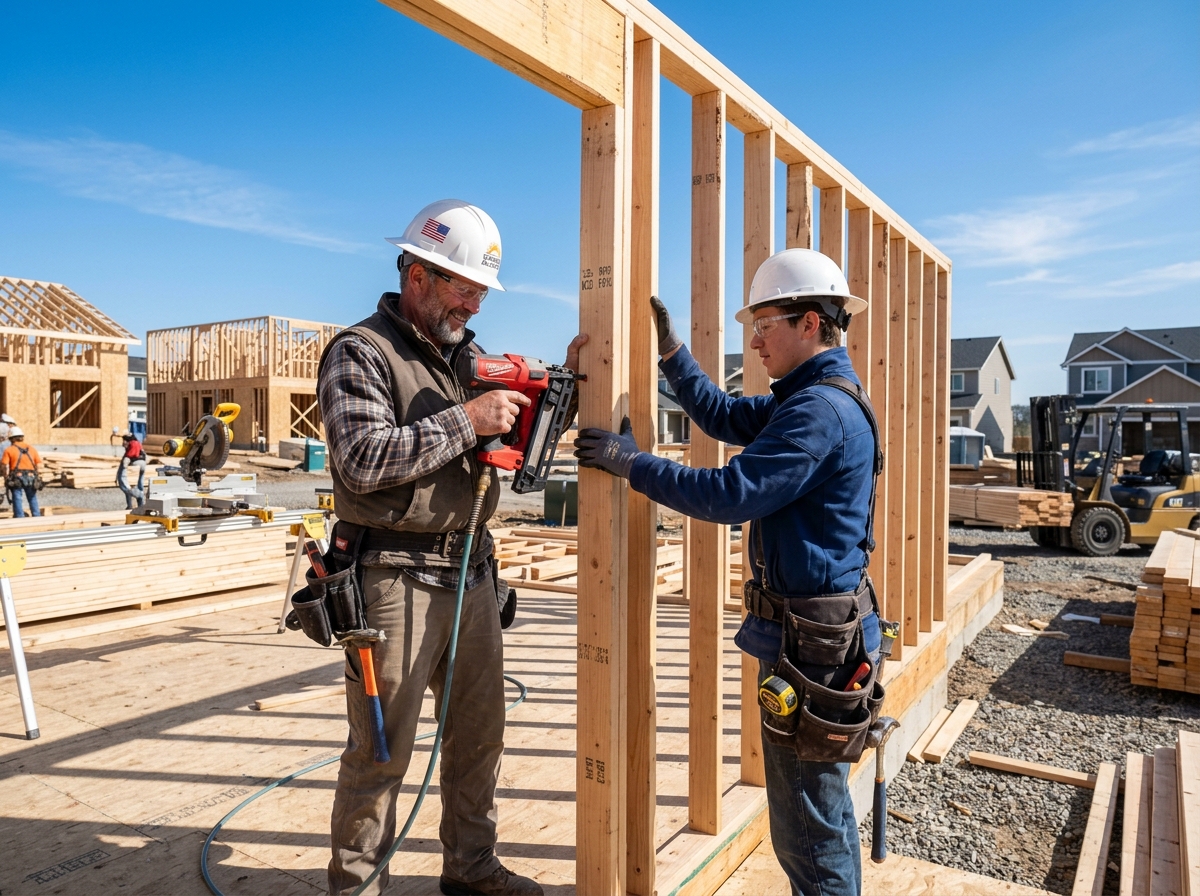
As a framing carpenter labor helper, your day is a mix of high-energy physical work and precision tasks. You aren’t just moving wood; you are helping create the components that make up a home or commercial building. You will spend a lot of time loading-unloading-and-general-staff duties, but your core value lies in your ability to assist with actual construction.
Daily Tasks of a Framing Carpenter Labor Helper
The Carpenter Helper Job Details usually include a variety of repetitive but vital tasks. On a typical day, you might:
- Laying out lumber: Sorting and positioning wood according to the carpenter’s marks.
- Assembling wall sections: Nailing together the studs, plates, and headers that form a wall.
- Installing blocking: Putting in the small pieces of wood between studs that provide extra support for cabinets or fixtures.
- Tie spacing: Ensuring that metal ties and fasteners are placed correctly to secure the framework to the foundation.
- Site organization: Keeping the work area clean to prevent accidents and ensure tools are always within reach.
Assisting with Specialized Framing
As you gain experience, you’ll move beyond simple wall studs. You will assist with truss installation—those heavy triangular frames that make up the roof. This often involves working at heights and requires a steady hand.
You’ll also learn how-to-nail-your-search-for-siding-laborers skills by helping with soffit building and bulkhead assembly. These are the more detailed parts of the frame that require precise measurements and careful fastener installation. You may also be tasked with setting up temporary scaffolding, which is critical for safety when working on multi-story structures.
Skills, Education, and Physical Requirements
To succeed in uae-civil-construction-jobs or positions in the USA and Middle East, you need a specific blend of grit and “math-ability.”
Most employers require at least a high school diploma or GED. However, the most important “requirement” is your physical condition. You must be able to lift and carry 50 to 75 lbs regularly—sometimes for long distances across uneven terrain. Physical stamina is non-negotiable, as you will be working in all types of outdoor conditions, from the humid heat of Muscat to the biting cold of a New York winter.
How to Become a Framing Carpenter Labor Helper
Entering the field of civil-jobs is often about who you know and what you’re willing to learn. Many helpers start through on-the-job training. You show up, work hard, and the lead carpenter teaches you the ropes.
However, if you want to advance quickly, consider:
- Apprenticeship paths: Formal programs that combine classroom learning with paid work.
- Math proficiency: You don’t need calculus, but you must be able to add and subtract fractions (like 5/8″ and 3/16″) in your head while holding a tape measure.
- Manual dexterity: Being comfortable with your hands and having good hand-eye coordination is essential for using saws and nail guns safely.
Certifications and Safety Training
Safety isn’t just a suggestion; it’s a job requirement. Most reputable framing companies will require or provide OSHA 10 training, which covers basic construction safety. If you want to stand out, look into NARI (National Association of the Remodeling Industry) certifications or AGC (Associated General Contractors) standards.
You should also be prepared for administrative requirements. Many jobs, especially in the US, require drug testing and e-Verify checks. Knowing how-to-land-electrical-helper-labor-jobs-today often starts with having your safety certifications ready to go before you even apply.
Salary and Career Progression in Framing
The financial outlook for a framing carpenter labor helper is surprisingly strong due to massive labor shortages. In 2020, for instance, 74% of contractors in Illinois reported a shortage of framing carpenters. This high demand means higher wages for those willing to do the work.
While entry-level helpers might start in the $17 to $22 per hour range, the ceiling is much higher. Experienced framing carpenters in the United States earn an average of $51,193 per year, with some specialists making over $60,000.
From Helper to Lead Carpenter
The path from helper to lead is paved with skill acquisition. As you master tasks, you move from “carrying wood” to “cutting wood” to “laying out the house.”
- Skill Acquisition: Learning to read blueprints independently.
- Tenure Bonuses: Many companies offer raises based on how long you’ve stayed with the crew.
- Performance Raises: If you are the fastest, most accurate nailer on the crew, you’ll see it in your paycheck.
- Supervisory Roles: Moving into a site supervisor or project manager position.
- Contracting Business: Many framers eventually start their own business, which is a common goal for those in oil-and-gas-civil-and-construction-jobs.
Safety and Tools for the Modern Framer
You can’t build a house with your bare hands. A framing carpenter labor helper needs to become an expert in “tool talk.”
Common tools you will use include:
- Nail Guns: Pneumatic or cordless, these are the workhorses of the framing world.
- Circular Saws: Used for cutting studs and sheathing to exact lengths.
- Levels and Measuring Tapes: Precision is everything; if the frame is off by half an inch, the windows won’t fit later.
- PPE (Personal Protective Equipment): This includes hard hats, high-visibility vests, and fall protection harnesses for roof work.
Tool maintenance is also part of the job. A helper who keeps the saws sharp and the nail guns oiled is a helper who gets promoted.
Frequently Asked Questions about Framing Carpenter Labor Helpers
What is the difference between a framing helper and a general laborer?
A general laborer focuses on site maintenance and material moving (cleaning up, hauling trash). A framing helper assists specifically with the assembly of the building (holding boards, nailing, measuring).
Do I need prior experience to apply for a framing helper position?
Not always! Many seasonal and entry-level roles require zero experience. However, having 3 months of experience or a basic understanding of hand tools will often get you a higher starting wage.
What are the most common physical demands on a framing job site?
The most common demands are lifting 50-75 lbs, standing for 8-10 hours a day, and working on ladders or at heights. You must also be comfortable working in extreme weather, whether it’s the heat of Saudi Arabia or the rain in Seattle.
Conclusion
At Elite Innovation LLC, we know that the “bones” of a building are its most important part. Becoming a framing carpenter labor helper isn’t just a job—it’s a career choice that offers immediate rewards and long-term growth. Whether you are looking for work in Muscat, Karachi, New York, or Riyadh, the demand for skilled structural builders has never been higher.
If you are ready to trade your desk for a hammer and build something that will last for decades, there is a spot on the crew waiting for you.
Explore current openings in construction and civil works today and start your journey from helper to master carpenter!