
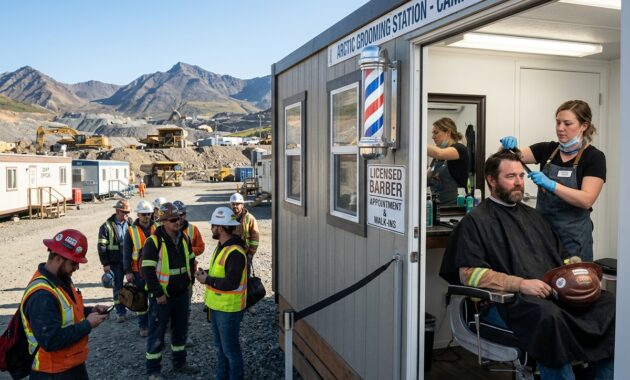

Why Rotational Barber FIFO Camps Matter for Remote Workers and Camp Operators
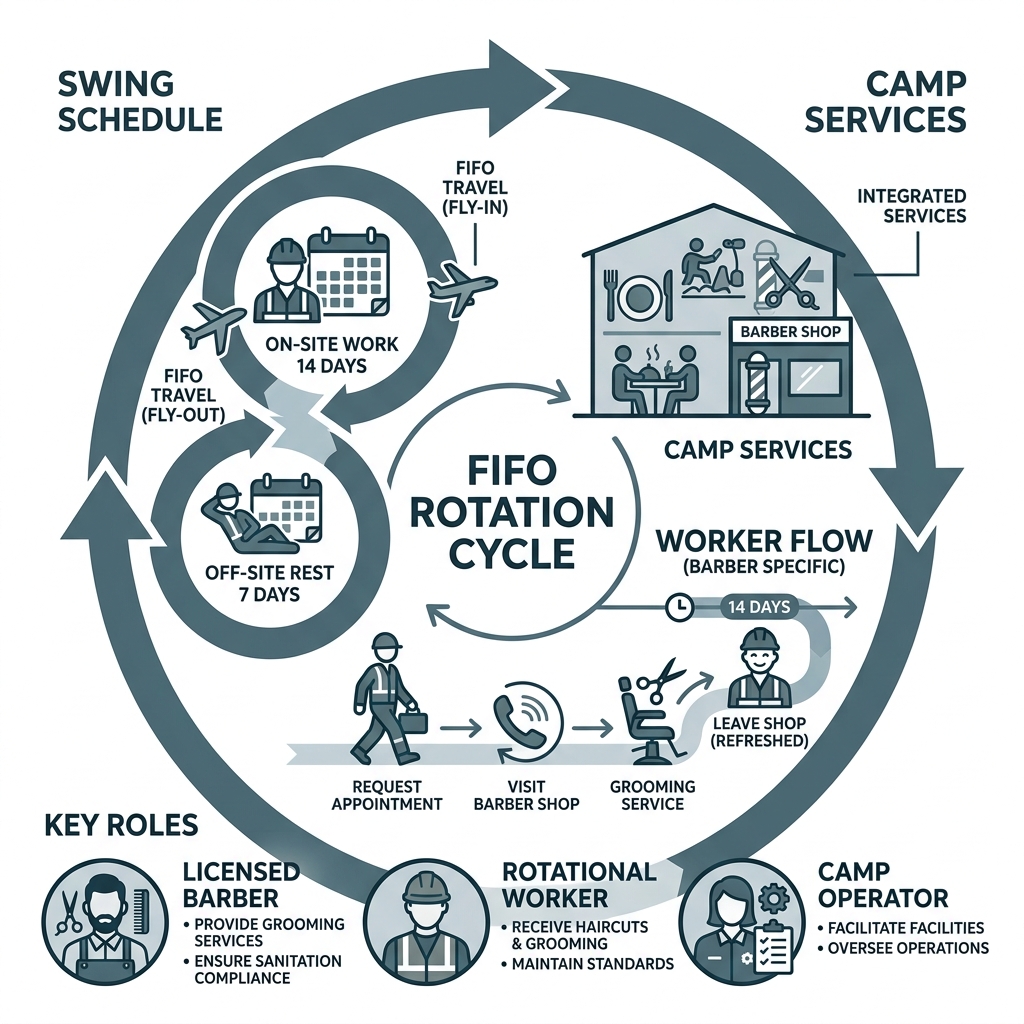
Rotational barber FIFO camps are permanent or semi-permanent grooming service operations embedded within fly-in fly-out work camps at remote resource extraction sites, where licensed barbers work on rotating schedules to provide haircuts and grooming to a workforce that can number in the tens of thousands.
Here is a quick breakdown of what they involve:
| Feature | Details |
|---|---|
| Location | Remote oil, gas, and mining camps (e.g., Athabasca Oil Sands, Pilbara WA) |
| Rotation schedule | Typically 14 days in / 7 days out, fly-in fly-out |
| Who they serve | Rotational workers on 10-12 hour shifts, majority male |
| Key duties | Haircutting, sanitation compliance, inventory, safety checks |
| Why they exist | Worker well-being, grooming standards, and social support in isolated camps |
| Typical wage (Canada) | Around $28/hr with full accommodations provided |
Between 2000 and 2014, the mobile workforce at Canada’s Athabasca Oil Sands alone grew nearly ten times over — reaching more than 50,000 rotational workers housed across 100+ camps. That is a small city, rebuilt from scratch every rotation, hundreds or thousands of kilometers from home.
Workers in these camps follow a relentless rhythm: wake, eat, work 12 hours, sleep, repeat. For weeks at a time. With no family, no familiar neighborhood, and no real sense of “normal” time.
That is where the barber comes in.
A haircut in a remote camp is not just a haircut. It is a break in the monotony. A brief moment of normalcy. A small piece of the outside world carried into an environment designed almost entirely around industrial output.
For workers seeking stable blue-collar roles in remote sites, understanding how grooming and personal care services operate inside FIFO camps is genuinely useful — both as a career pathway and as a window into what daily life in these environments actually looks like.
Know your rotational barber fifo camps terms:
The Strategic Value of Rotational Barber FIFO Camps

In the high-stakes world of resource extraction, the “mobility regime” is everything. Companies no longer build permanent towns; they build flexible, high-density camps that can be scaled up or down based on the price of a barrel of oil or a ton of iron ore. Within this regime, rotational barber fifo camps serve as a critical infrastructure component. They aren’t just a luxury; they are a strategic tool used to manage what researchers call “liminal time.”
Liminal time is that “betwixt and between” state where workers aren’t quite at home and aren’t quite at work—they are in the camp, waiting for the next shift. Managing this time effectively is the difference between a productive crew and a workforce suffering from “shack wacky” syndrome (extreme cabin fever). According to Scientific research on managing liminal time in FIFO camps, these camps function as para-productive entities. This means that while the barber isn’t pulling oil out of the ground, their work is essential for the “social reproduction” of the people who do.
Understanding the oil rig rotation schedules and pay helps illustrate why these services are so vital. When a worker is on a 21-day “swing,” the camp becomes their entire universe. A barber shop provides a rare “third space” outside the mess hall and the sleeping quarters.
How Rotational Barber FIFO Camps Support Social Reproduction
Social reproduction is a fancy way of saying “keeping humans functioning so they can go back to work tomorrow.” In a FIFO environment, this is a massive undertaking. Barbers contribute to this by providing grooming rituals that help workers shed the “industrial” version of themselves and reconnect with their personal identity.
When a worker sits in a barber’s chair, they engage in social time that is distinct from the “dressage rhythms” of the worksite. It is a moment of care in a world of steel and concrete. This service is a bridge; it allows a worker to look in the mirror and see a person, not just a badge number or a hi-vis vest. For the industry, this results in better mental health and higher retention rates.
Integration into Global Production Networks
The modern resource camp is an “enclave”—a self-contained bubble connected to global production networks. Whether in the USA, Saudi Arabia, or Qatar, these camps rely on a mobile labor force that travels thousands of kilometers to work.
Research on FIFO and global production networks suggests that as companies move away from permanent settlements, the responsibility for worker well-being shifts to the camp service providers. Rotational barber fifo camps are now part of the global standard for these enclaves, ensuring that no matter how remote the location, the labor force remains disciplined, groomed, and ready for the 24/7 demands of global extraction.
Managing Liminality: Temporal Tactics of Remote Barbers
Life in a FIFO camp is a battle against time. Workers often describe it as “Groundhog Day”—a loop of monotony that can lead to disorientation and a feeling of entrapment. Barbers in these environments face the same challenges, but they also act as “time managers” for their clients.
| Tactic | Description | Goal |
|---|---|---|
| Routinizing | Creating strict daily schedules and mapping out the camp. | Combatting disorientation and “brain scramble.” |
| Disrupting | Purposefully changing small habits or skipping the usual mess hall route. | Breaking the soul-crushing monotony of “eat-work-sleep.” |
| Syncing | Aligning camp life with “outside” time (calling home, following news). | Maintaining a connection to the real world. |
| Future-Orienting | Focusing on the “end of the swing” or financial goals. | Enduring present isolation for a future reward. |
As noted in Managing liminal time in the fly-in fly-out work camp, workers use these tactics to survive. The barber shop is a key site for “disrupting” the routine. It provides a destination that isn’t the worksite or the bedroom.
Developing Liminality Competence
To succeed as a barber in a rotational camp, one must develop “liminality competence.” This is the ability to live comfortably in a state of permanent transition. You are never fully “at home” in the camp, but you aren’t a guest either.
Barbers learn to reconstruct their identities within these spaces. They aren’t just stylists; they are listeners, unofficial counselors, and keepers of camp culture. Learning how to survive a housekeeping rotation offshore or in a remote camp involves mastering these same social nuances. You have to “get along to get along,” as the saying goes.
Temporal Tactics for Rotational Workers
We see workers using “syncing” tactics every day. A barber might hear about a client’s daughter’s graduation or a home renovation project. By discussing these “outside” events, the barber helps the worker sync their internal clock with the world beyond the camp fence. This is the ultimate defense against “shack wacky” effects—the psychological strain of being confined to a small, industrial space for too long.
Gendered Dynamics and the Para-Productive Role of Grooming
Resource extraction is a heavily masculinized world. In the Athabasca Oil Sands, for instance, the vast majority of rotational workers are men. This creates a specific “frontier masculinity” culture where toughness and endurance are prized. In this environment, the barber shop takes on a unique role.
Masculinity in Resource Extraction
In a world of 12-hour shifts and heavy machinery, grooming standards serve a dual purpose. First, there are safety requirements—long beards can interfere with respirators and PPE. Second, there is the social aspect of “looking the part.”
Finding 14 on 14 off oilfield jobs is often about entering this masculinized space. For many men, the barber shop is the only place in camp where it is socially acceptable to receive “care.” It is a grooming ritual that allows for a brief relaxation of the “tough guy” exterior. Gendered circuits of care in the oil sands highlights how these services provide the emotional support that is often missing in industrial environments.
The Barber as a Bridge to Personal Life
Whether the barber is male or female, they perform significant emotional labor. They act as a bridge between the worker’s industrial life and their personal life. By helping a worker “clean up” before their flight home, the barber facilitates the transition back to being a father, a husband, or a friend. This “re-entry” grooming is a vital part of the FIFO cycle. It helps mitigate the relational costs of being away for weeks at a time, allowing workers to return home feeling like themselves again.
Operational Challenges: Rhythms, Economics, and Physical Costs
Operating rotational barber fifo camps is a logistical marathon. It isn’t just about cutting hair; it’s about syncing with the “dressage rhythms” of the camp. Everything is timed.
Labor Standards for Rotational Barber FIFO Camps
Barbers in these camps must adhere to strict operational standards that go far beyond a typical street-side shop.
- HACCP & Health Compliance: In many jurisdictions, personal service establishments in camps must follow rigorous health guidelines and sanitation protocols to prevent outbreaks in high-density housing.
- Inventory Management: You can’t just run to the store if you out of neck strips or disinfectant. Everything must be flown in or trucked in weeks in advance.
- Safety Audits: Barbers are often required to participate in daily “toolbox talks” and safety inspections, just like the tradespeople they serve.
The offshore rotational jobs model often sets the standard for these strict regulations, where every square inch of space and every minute of time is accounted for.
The Physical and Relational Toll on Service Staff
The 12-hour shift is standard in FIFO life, and it takes a toll. For barbers, this means 12 hours on their feet in a high-pressure environment. There is also the “Freaky Friday” phenomenon—the chaotic rotation changeover days where everyone wants a haircut before they fly out.
The isolation is real. Service staff often experience the same “brain scramble” as the extraction workers. Mitigation strategies include strict fatigue management, ensuring staff have access to the same gyms and recreation facilities as the miners, and providing robust Wi-Fi to maintain family connections.
Frequently Asked Questions about Remote Grooming Services
What are the primary benefits of rotational barber FIFO camps?
The primary benefits include improved worker morale, better mental health through social interaction, and compliance with safety grooming standards (like respirator fit). They also provide a sense of “normalcy” in an otherwise industrial environment, which helps with workforce retention.
How do economic cycles affect barber services in remote sites?
During “boom” cycles, demand for rotational barber fifo camps skyrockets as workforce numbers swell. During “bust” cycles, services may be scaled back or consolidated. However, because a core maintenance workforce is always required to keep facilities running, there is a baseline demand that remains relatively stable even during downturns.
What qualifications are required for barbers in FIFO environments?
Typically, a barber needs a valid professional license, at least 2 years of experience, and the ability to pass a comprehensive medical exam (including drug and alcohol screening). Because these are “para-productive” roles, barbers must also be comfortable with camp life, 12-hour shifts, and strict safety protocols.
Conclusion
At Elite Innovation LLC, we recognize that the success of a remote camp isn’t just measured in production numbers—it’s measured in the health and stability of the people living there. Rotational barber fifo camps represent a sophisticated intersection of business, psychology, and labor policy.
As we look toward the future of rotational jobs, it is clear that “liminal organizations” like these will play an even larger role. By treating grooming and wellness as essential infrastructure rather than an afterthought, camp operators can build more resilient, productive, and human-centric work regimes. Whether you are a worker looking for your next swing or an operator looking to improve your camp’s “liminality competence,” the barber shop remains a small but mighty pillar of the remote work world.