

What Is Warehouse General Labor — and Is It Right for You?
Warehouse general labor is one of the most widely available job categories in the U.S., covering roles like loading and unloading freight, moving stock, filling orders, and keeping distribution centers running smoothly.
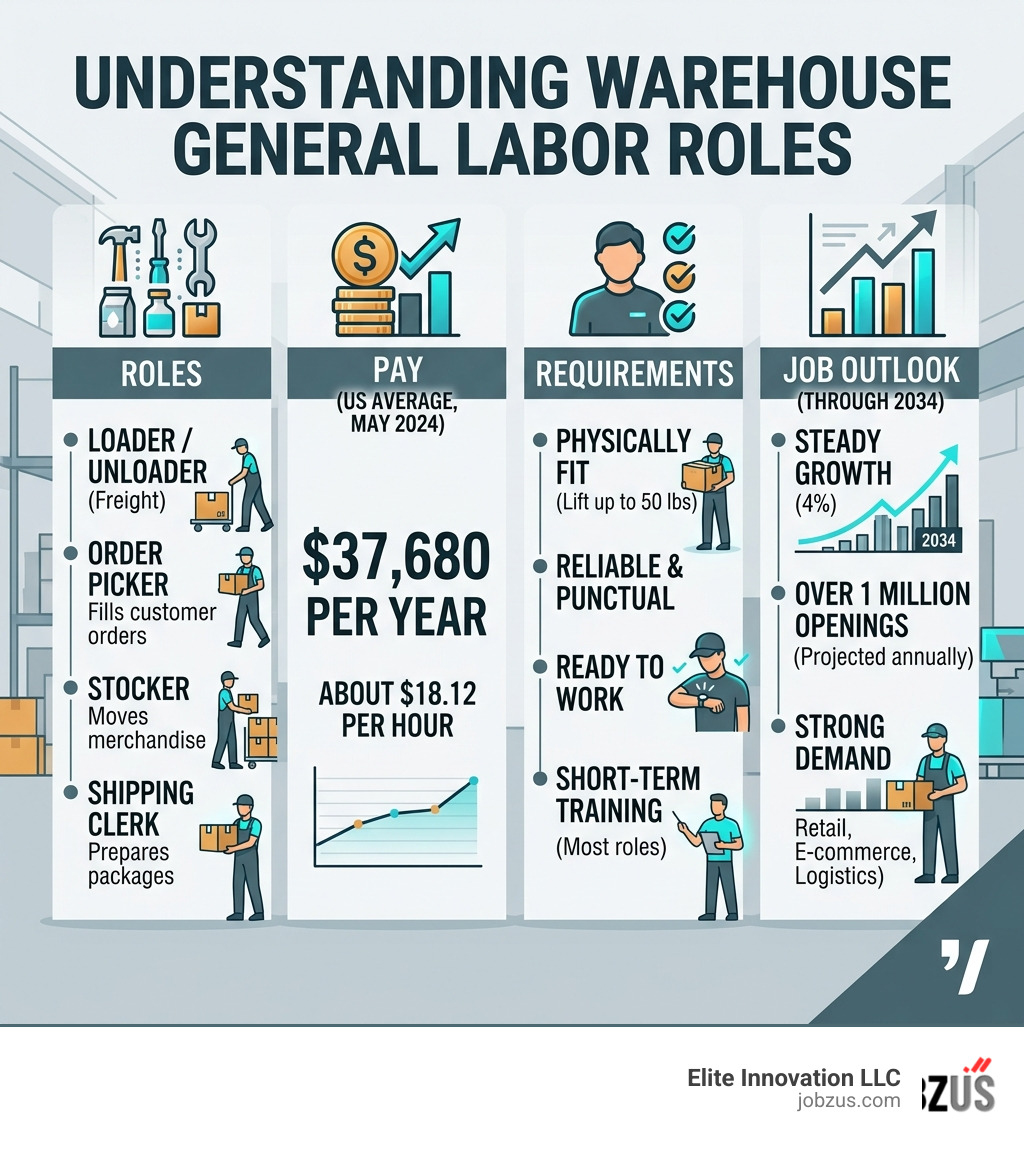
Here’s a quick breakdown of what you need to know:
- What it is: Physical, hands-on work in warehouses, fulfillment centers, and distribution hubs
- Who it’s for: Anyone who is physically fit, reliable, and ready to work — no degree required
- Average pay: $37,680 per year (about $18.12/hour) as of May 2024
- Job availability: Over 1 million openings projected every year through 2034
- Entry barrier: Low — most roles require only short-term on-the-job training
These jobs are everywhere. Retail, food distribution, e-commerce, freight forwarding — nearly every supply chain depends on warehouse workers to keep things moving.
And with 7 million people already working in this field and steady 4% growth projected through 2034, the demand is real and consistent.
Whether you’re looking for your first stable paycheck or want to build a long-term career in logistics, warehouse work offers a clear, accessible path in. The physical demands are real — most roles require lifting up to 50 pounds regularly and staying on your feet for long shifts — but so are the rewards: steady hours, competitive pay, and benefits with many employers.
This guide covers everything you need to know, from daily duties and required skills to pay rates, safety, and how to land your next role.
Warehouse general labor helpful reading:
Understanding the World of Warehouse General Labor
As we move through April 2026, the industrial landscape has never been more vibrant. When we talk about warehouse general labor, we are referring to the backbone of the global economy. These are the hand laborers and material movers who ensure that the products you order online or buy at the local market actually make it to the shelf or your front door.
In 2024, hand laborers and material movers held approximately 7.0 million jobs. This massive workforce is divided into several key subgroups. The largest of these is “Laborers and freight, stock, and material movers, hand,” accounting for nearly 3 million positions. Close behind are stockers and order fillers, with over 2.7 million jobs.
Whether you are in New York, Karachi, Muscat, or Kuala Lumpur, the fundamentals of the job remain the same: moving things from Point A to Point B efficiently and safely. For a deeper dive into the specific mechanics of moving goods, check out The Ultimate Guide to Loading Unloading Work Jobs.
Key Responsibilities in Warehouse General Labor
What does a typical day look like for us in the warehouse? It is rarely a “sit-down” kind of job. The core of warehouse general labor involves a cycle of receiving, storing, picking, and shipping.
- Receiving and Unloading: When a trailer arrives, laborers are responsible for unloading cartons and boxes. This often involves continuous lifting of items up to 50 pounds.
- Inventory Tracking and RF Systems: Modern warehouses aren’t just about muscle; they’re about data. We use Radio Frequency (RF) scanners and Warehouse Management Systems (WMS) to track every item. You’ll verify product identity, quantity, and condition against digital records.
- Staging and Storage: Once received, freight must be “put away” in designated areas. This might involve hand-stacking products or using pallet jacks to move goods to the correct aisle.
- Order Selection: Also known as “picking,” this is where you pull specific items to fulfill customer orders. Accuracy is everything here.
- Shipping and Loading: The final step involves shrink-wrapping pallets, labeling outgoing orders, and operating power equipment to load trailers for delivery.
For those interested in the specific personnel structures within these facilities, Loading Unloading and General Staff provides excellent context on how teams are organized.
Specialized Roles within Warehouse General Labor
While “General Laborer” is a common catch-all term, many facilities offer specialized paths that allow you to hone specific skills:
- Fulfillment Center Associate: Common in e-commerce, these roles focus on prepping customer packages and sorting them for rapid delivery.
- Warehouse Selector: These pros drive reach trucks or electric pallet jacks to pull products from high shelves. In many companies, selectors can earn “production pay,” which rewards speed and accuracy with higher hourly rates.
- Warehouse Loader: Loaders focus specifically on the “tetris” of the trailer. They ensure “product walls” are stable so nothing shifts or breaks during transit.
- Grocery/Cold Storage Associate: Working in refrigerated or freezer sections. Companies usually provide the “freezer suits,” gloves, and hats needed to stay warm.
- XL Warehouse Associate: Specializing in heavy items over 50 pounds, often using specialized lift equipment or working in teams to move bulky freight.
International opportunities abound in these roles, with active hiring seen in Saudi Arabia, Qatar, and Malaysia.
Skills and Qualifications for Entry-Level Success

The beauty of warehouse general labor is that the door is wide open for those willing to put in the work. Most entry-level positions do not require a formal degree, but there are certain qualities that will make you stand out from the crowd.
- Physical Stamina: You will be on your feet for the majority of your shift. The ability to lift 50 pounds (and sometimes up to 100 pounds for loaders) on a frequent basis is a standard requirement.
- Time Management: Warehouses run on tight schedules. Being able to pace yourself so you don’t burn out by lunch—while still meeting your “picks per hour” goal—is a vital skill.
- Communication: Whether it’s a shift handoff or signaling a forklift operator, clear communication prevents accidents and confusion.
- Basic Tech Savvy: You don’t need to be a computer programmer, but you should be comfortable using handheld scanners and basic digital interfaces.
If you are just starting out, we recommend looking at Entry Level General Labor Jobs for the Total Newbie to get your bearings. Once you’re ready to apply, How to Land General Labor Jobs Without Breaking a Sweat offers tips on navigating the application process.
The Certification Edge
While not always required for day one, having a forklift certification or a valid driver’s license can give you a major advantage. Many companies offer immediate pay bumps for those who can operate reach trucks, cherry pickers, or electric pallet jacks. You can often obtain these certifications through vocational schools or even online courses before you even apply.
The Work Environment: Physical Demands and Safety
Working in warehouse general labor is an athletic endeavor. It is important to know what you are signing up for so you can succeed long-term.
Shift Schedules
Warehouse work often operates 24/7. This means you might find yourself working:
- Standard 8-hour shifts.
- Compressed 10-hour or 12-hour shifts (often 4 days on, 3 days off).
- Overnight, weekend, or holiday shifts.
The flexibility can be great for those who want to avoid the “9-to-5” grind, but it requires a disciplined sleep schedule.
Safety and OSHA
Safety is the number one priority in any reputable warehouse. Because of the heavy lifting and moving machinery, these roles have historically had higher injury rates. However, in April 2026, technology and strict OSHA (Occupational Safety and Health Administration) standards have made warehouses safer than ever.
Expect to participate in regular safety training. You’ll learn how to lift with your legs, not your back, and how to stay visible to machine operators. In specialized environments like New York City or major logistics hubs in the Middle East, safety protocols are often the first thing you’ll learn during orientation.
If you are transitioning from a different type of labor, such as construction, you might find the safety culture similar. You can read more about those parallels in How to Nail Your First Construction General Labor Job.
Pay, Benefits, and the 2026 Job Outlook
Let’s talk numbers. As of May 2024, the median annual wage for hand laborers and material movers was $37,680, which breaks down to roughly $18.12 per hour. However, this varies significantly based on your location and the specific role.
For example, a Warehouse Specialist I might start at a training rate of around $19.50, but once they hit “100% production” speed, that rate can jump to $23.00 or even $27.00 per hour.
Benefits
Many large employers offer benefits that start quite early—sometimes as soon as the 60th day of employment. These typically include:
- Medical, dental, and vision insurance.
- 401(k) plans with company matching.
- Paid time off (vacation and sick days) starting from day one.
- Tuition reimbursement for those looking to move into management or logistics engineering.
The Impact of Automation
A common question we hear is: “Will robots take my job?” While automation is increasing, it is largely changing the nature of the work rather than eliminating it. Robotic arms now handle some of the bulkiest sorting, and automated “ErgoPick” systems help bring items to the worker, reducing the need for constant walking. This actually makes the job less physically punishing and allows humans to focus on tasks that require detail and problem-solving.
Job Outlook Comparison
The employment of hand laborers and material movers is projected to grow 4% through 2034. This is considered “as fast as average” for all occupations. With over 1 million annual openings projected due to retirements and workers moving into other roles, the demand is incredibly stable.
| Industry Sector | % of Laborers Employed |
|---|---|
| Retail Trade | 34% |
| Transportation & Warehousing | 21% |
| Manufacturing | 12% |
If you’re curious how warehouse pay stacks up against other entry-level labor roles, Current Openings How to Land Electrical Helper Labor Jobs Today offers a great comparison point for the skilled trades.
Frequently Asked Questions about Warehouse Work
What does a general warehouse worker do on a daily basis?
A general worker handles the physical flow of goods. This includes unloading trucks, checking items against a manifest using an RF scanner, storing products on shelves, picking items for customer orders, and loading pallets onto outgoing trailers. They also spend time maintaining a clean and safe work area.
How physically demanding is the job?
It is a high-activity role. You should be prepared to stand for 8 to 10 hours and lift items weighing 50 pounds or more repeatedly. While technology like height-adjustable workstations and pallet jacks help, you will still get a full-body workout every single shift.
What are the most important qualities for success?
Reliability is #1—warehouses depend on every team member showing up on time. Beyond that, a focus on safety, attention to detail (so customers get the right items), and a “team-first” attitude are the keys to moving up the ladder.
Conclusion
Warehouse general labor is more than just a job; it’s a gateway into the massive world of global logistics. Whether you are starting in Muscat or Karachi, the skills you learn—from inventory management to equipment operation—are transferable across the globe.
At Elite Innovation LLC, we see the value in the collective effort of every warehouse team member. The industry has evolved significantly by April 2026, offering better pay, enhanced safety through technology, and clearer paths for career progression into supervisory or logistics roles.
If you’re ready to take the next step in your career and join a workforce that keeps the world moving, now is the perfect time to dive in.

