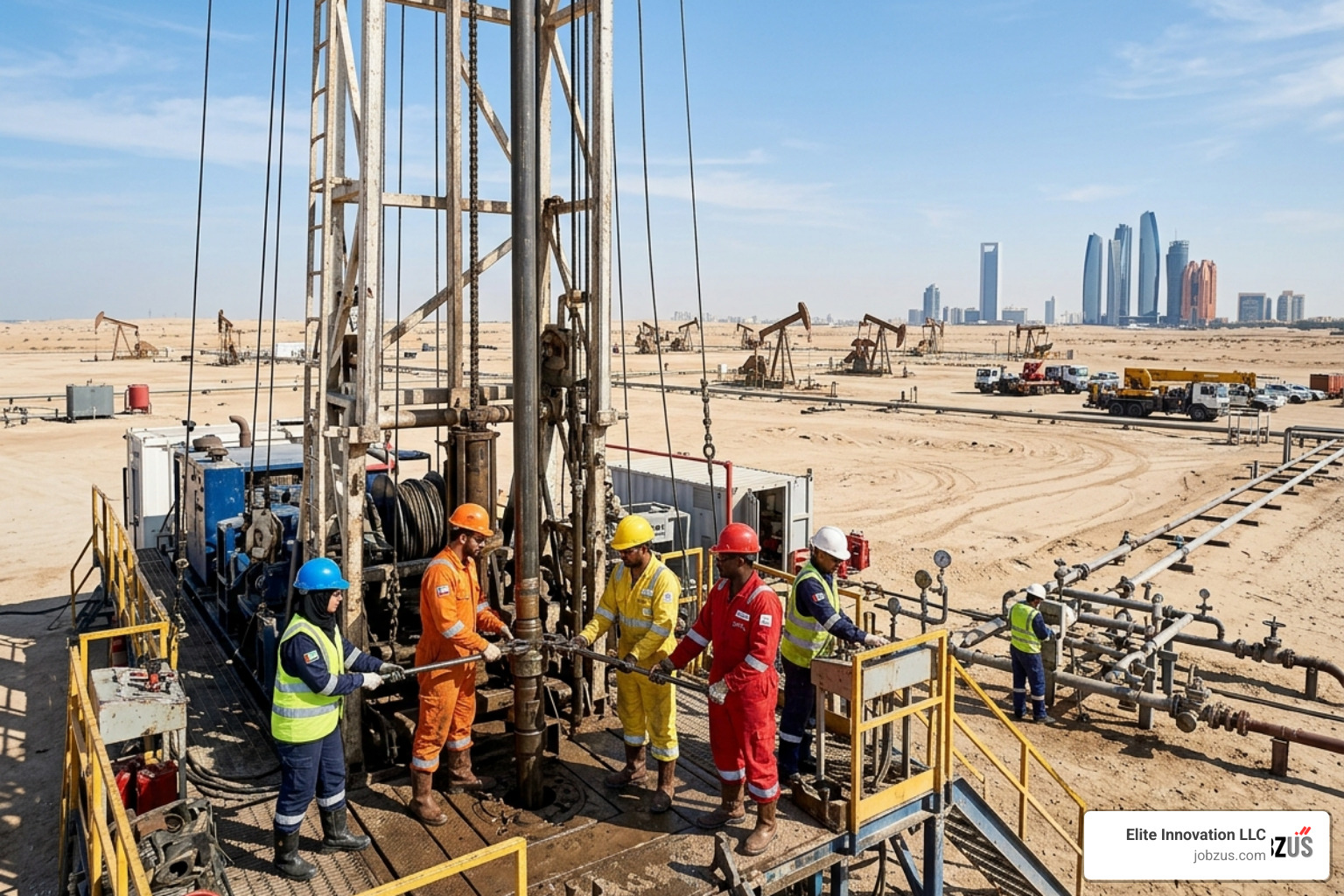
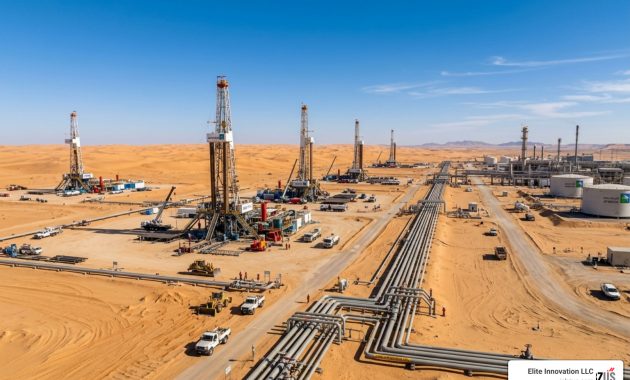

Saudi Arabia’s Oil and Gas Industry: Who Are the Major Players?
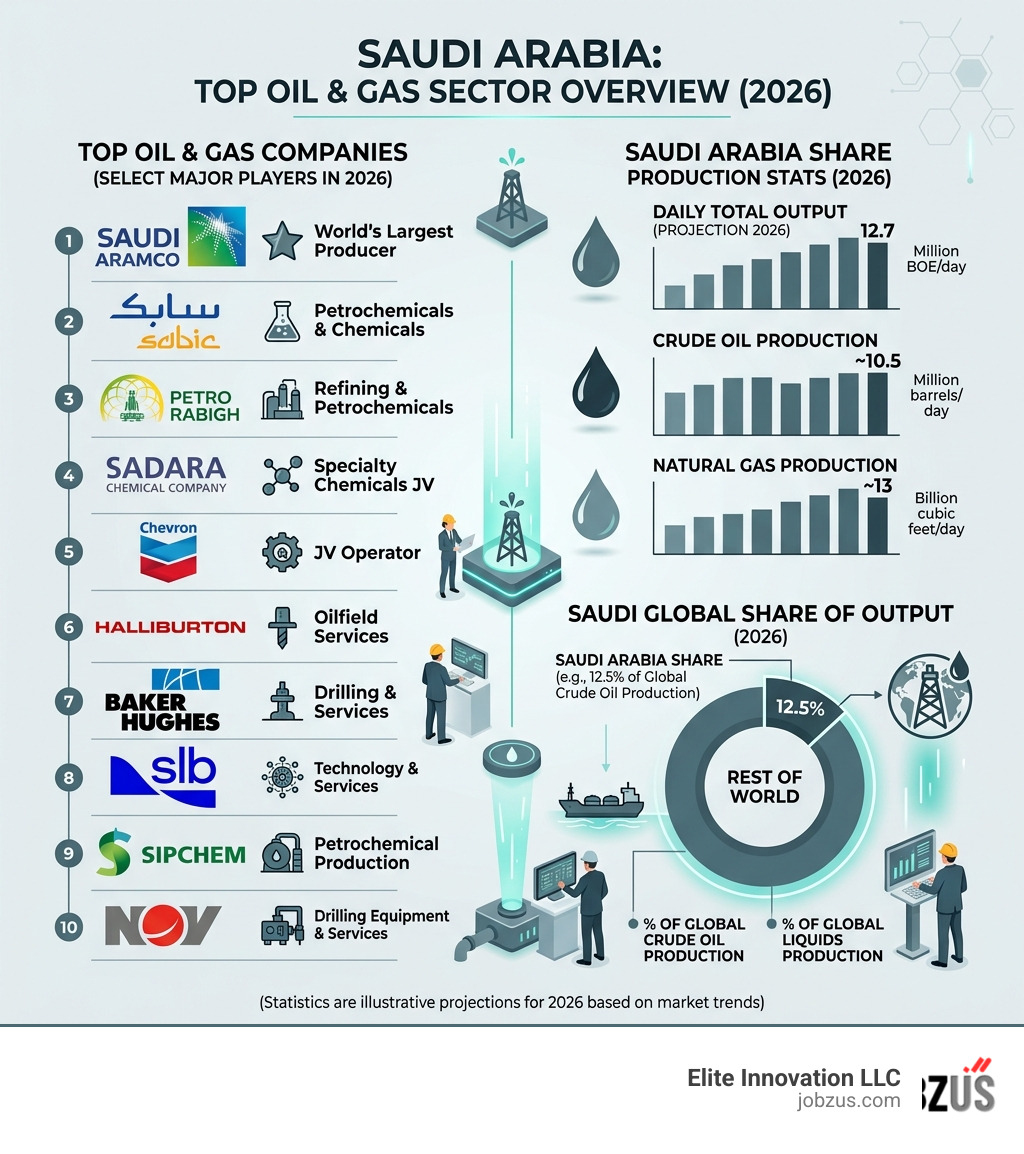
The oil and gas companies in Saudi Arabia form one of the most powerful energy ecosystems on the planet. Saudi Arabia sits on over 270 billion barrels of proven crude oil reserves and produces roughly 12.7 million barrels of oil equivalent every single day.
If you’re looking for a quick overview of the top companies operating in this sector, here they are:
- Saudi Aramco – State-owned giant; world’s largest oil producer
- SABIC – Leading petrochemicals and chemicals manufacturer
- Petro Rabigh – Integrated refining and petrochemicals
- Sadara Chemical Company – Specialty chemicals joint venture
- Saudi Chevron – International joint venture operator
- Halliburton – Global oilfield services provider
- Baker Hughes – Drilling and well completion services
- SLB (Schlumberger) – Technology and oilfield services
- Sipchem – Petrochemical production in Jubail
- National Oilwell Varco (NOV) – Drilling equipment and services
Saudi Arabia’s oil and gas sector contributes around 50% of the Kingdom’s GDP and accounts for more than 70% of its total export earnings. With over 75 major oil and gas entities active in the country — and hundreds more supporting businesses — this industry touches virtually every corner of the Saudi economy.
That means massive demand for workers at every level. From engineers and technicians to laborers in loading, logistics, and field operations, the sector is one of the most reliable sources of industrial employment in the region.
Terms related to oil and gas companies in saudi arabia:
The Strategic Importance of Oil and Gas Companies in Saudi Arabia
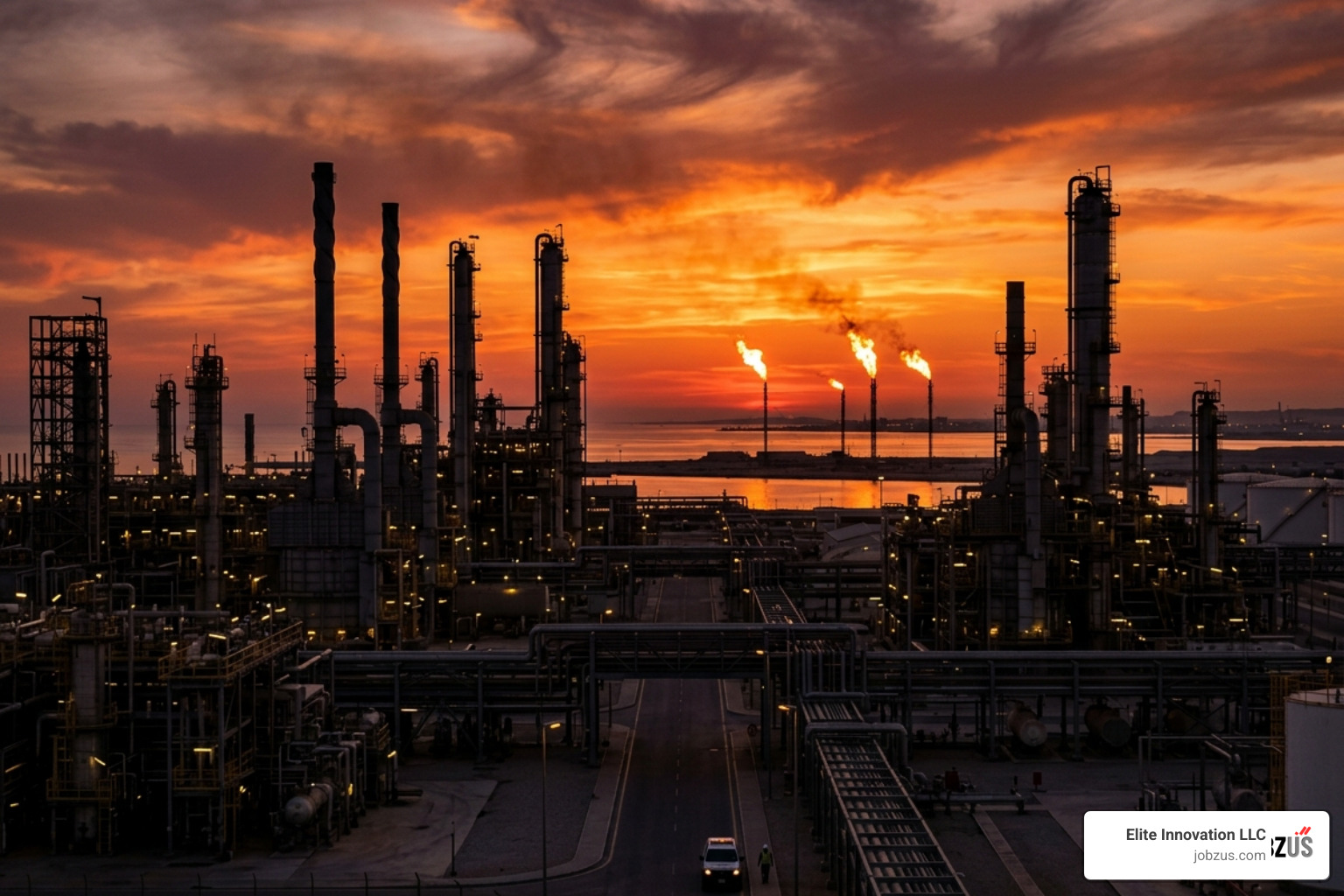
As we look at the landscape in April 2026, the significance of the energy sector in the Kingdom cannot be overstated. Saudi Arabia isn’t just a participant in the global energy market; it is its heartbeat. The oil and gas companies in Saudi Arabia are the primary engines driving the nation’s ambitious Vision 2030, a roadmap designed to diversify the economy while maximizing the value of its natural resources.
Currently, the sector contributes approximately 50% of the Kingdom’s GDP. While Vision 2030 aims to grow non-oil revenue, the hydrocarbon industry provides the essential capital needed for that very transition. With proven crude oil reserves exceeding 270 billion barrels, the Kingdom holds a unique position of influence within OPEC, often acting as the “swing producer” that stabilizes global pricing and supply.
Infrastructure is the backbone of this dominance. The Master Gas System (MGS), an extensive network of pipelines and processing plants, allows the Kingdom to utilize natural gas for domestic power generation and industrial feedstock, significantly reducing the need to burn crude oil locally. This strategic setup ensures that the maximum amount of high-value liquid gold is available for international export.
Beyond simple extraction, we are seeing a massive shift toward downstream expansion. The goal is no longer just to ship raw crude; it is to transform that crude into high-value chemicals, polymers, and specialty materials right here in the Middle East. This transition from “wellhead to consumer” is creating thousands of specialized jobs and fostering a new era of energy security.
Top 10 Major Players in the Saudi Energy Sector
The industry is a mix of state-owned titans, massive international service providers, and specialized petrochemical firms. While many people only know the big name at the top, the ecosystem is actually quite diverse, featuring over 326 companies listed in various business databases.
To help you understand the scale, here is a comparison of some of the heavy hitters:
| Company | Main Focus | 2025/2026 Context |
|---|---|---|
| Saudi Aramco | Integrated Oil & Gas | 12.9 mmboed production; 99.9% reliability |
| SABIC | Petrochemicals | 70% owned by Aramco; global leader in chemicals |
| Saudi Chevron | Upstream Production | Major JV partner in the Partitioned Zone |
| Petro Rabigh | Refining & Chemicals | Critical hub for Red Sea energy logistics |
| Halliburton | Oilfield Services | Key partner in drilling and digitalization |
Saudi Aramco: The Leading Oil and Gas Company in Saudi Arabia
If the Saudi energy sector were a solar system, Saudi Aramco would be the sun. As of early 2026, Aramco manages a staggering 247.2 billion barrels of oil equivalent (boe) in total hydrocarbon reserves. It is, by almost any metric, the most profitable firm in history, reporting an adjusted net income of over $104 billion for the 2025 fiscal year.
Headquartered in Dhahran, Aramco operates the legendary Ghawar Field (the world’s largest onshore field) and the Safaniya Field (the world’s largest offshore field). But they aren’t just resting on their laurels. The company has set a bold target to achieve net-zero carbon emissions from its wholly-owned operations by 2060.
For those interested in the financial health and strategic direction of the company, the Investor overview | Aramco provides a deep dive into their capital allocation and 2025 results. With a workforce of over 76,000 employees and a 92-year history of excellence, they remain the undisputed leader among oil and gas companies in Saudi Arabia.
International Oil and Gas Companies in Saudi Arabia
While Aramco is the national champion, international players play a vital role in bringing cutting-edge technology and specialized services to the Kingdom. Companies like SLB (formerly Schlumberger), Halliburton, and Baker Hughes are the “boots on the ground” for complex drilling, well maintenance, and reservoir characterization.
Saudi Chevron represents one of the longest-standing international partnerships, operating in the Partitioned Zone between Saudi Arabia and Kuwait. Meanwhile, National Oilwell Varco (NOV) has become a cornerstone of the local manufacturing scene, providing the heavy hardware—rigs, bits, and valves—that keep the oil flowing. These firms are essential for technology transfer, ensuring that the Saudi workforce is trained on the world’s most advanced energy platforms.
Petrochemical and Downstream Leaders
The “Downstream” sector is where the real magic happens in 2026. This involves turning oil and gas into things we use every day, like plastics, fertilizers, and even fabrics.
- SABIC (Saudi Basic Industries Corporation): Now 70% owned by Aramco, SABIC is a global giant in chemicals and metals. They are currently leading the charge in “crude-to-chemicals” technology, which skips the traditional refining process to turn oil directly into chemical feedstock.
- Petro Rabigh: A massive joint venture between Aramco and Sumitomo Chemical, located on the Red Sea coast. It’s an integrated refinery and petrochemical complex that serves as a gateway to markets in Europe and Africa.
- Sadara Chemical Company: A multi-billion dollar JV with Dow Chemical, Sadara operates one of the world’s largest chemical complexes in Jubail Industrial City, focusing on specialty chemicals that weren’t previously produced in the region.
- Sipchem (Sahara International Petrochemical Company): A major player listed on the Saudi Exchange, Sipchem is known for its efficiency and high-quality chemical exports.
Sustainability, Technology, and Vision 2030
The oil and gas companies in Saudi Arabia are currently undergoing a massive digital and environmental makeover. In 2026, “sustainability” isn’t just a buzzword; it’s a core business strategy.
Digitalization and AI Through a high-profile partnership with Microsoft, Saudi Aramco and other regional players are deploying industrial AI to optimize everything from seismic imaging to pipeline leak detection. This “Digital Oilfield” approach allows companies to monitor thousands of wells in real-time, increasing safety and reducing operational costs.
Carbon Capture (CCUS) The Kingdom is becoming a global hub for Carbon Capture, Utilization, and Storage (CCUS). By capturing CO2 at the source—like a refinery or power plant—and pumping it back underground or using it to make blue ammonia, these companies are significantly lowering their Greenhouse Gas (GHG) emissions.
The iktva Program and Saudization One of the most impactful initiatives for the local economy is the In-Kingdom Total Value Add (iktva) program. This program requires suppliers to increase their local content—meaning they must hire Saudi nationals and manufacture goods within the Kingdom. In 2026, the iktva program officially hit its target of 70% local content. This has fundamentally changed the workforce, ensuring that the wealth generated by the energy sector stays within Saudi Arabia and creates sustainable careers for the next generation.
Frequently Asked Questions
What is the largest oil company in Saudi Arabia?
The largest is Saudi Aramco (the Saudi Arabian Oil Company). It is the national oil company and is widely considered the world’s most profitable firm. It manages over 270 billion barrels of proven crude oil reserves and has a market capitalization that has frequently hovered around the $2 trillion mark.
How many oil and gas companies operate in Saudi Arabia?
While Saudi Aramco is the dominant force, the sector is supported by a vast network. Industry directories like Lusha and GulfTalent list between 107 and 326 oil and gas companies in Saudi Arabia, ranging from major state entities to international service providers and local engineering firms.
What is the iktva program in the Saudi energy sector?
iktva stands for “In-Kingdom Total Value Add.” It is a flagship program launched by Saudi Aramco to drive supply chain efficiency and value creation within the Kingdom. The program recently achieved its goal of 70% localization, meaning 70 cents of every dollar spent by Aramco on its supply chain stays in the local economy through Saudi jobs, local manufacturing, and training.
Conclusion
As we navigate through 2026, the oil and gas companies in Saudi Arabia remain the bedrock of the global energy landscape. Whether it’s through the sheer scale of Saudi Aramco, the innovative chemical solutions of SABIC, or the high-tech services of international partners like Halliburton, this sector is a land of opportunity.
For job seekers, the industry has never been more accessible, thanks to the iktva program and the push for Saudization. For investors, the focus on CCUS, blue hydrogen, and digital transformation offers a glimpse into a sustainable, high-growth future. The energy transition is in full swing, and Saudi Arabia is leading the way.
If you’re ready to take the next step in your career, you can Explore oil and gas jobs in Saudi Arabia and join the workforce that powers the world.