


Why Industrial Manufacturing Recruitment Decides Whether Your Plant Thrives or Struggles
Industrial manufacturing recruitment is the process of finding, screening, and hiring qualified workers — from entry-level laborers to plant managers — for production environments where the right person in the right role directly affects safety, output, and profitability.
If you need a quick answer, here’s what effective manufacturing recruitment looks like in 2026:
- Define the role clearly — include physical requirements, shift schedules, safety certifications, and equipment experience
- Use specialized recruiters — not general agencies; manufacturing-specific firms have pre-vetted talent pools ready to deploy
- Screen for plant readiness — verify hands-on experience, OSHA familiarity, and ability to work in active production environments
- Choose the right staffing model — temp, temp-to-hire, or direct hire depending on urgency and budget
- Move fast — top candidates in trades and production roles are placed within days; slow hiring means losing them
The manufacturing sector is one of the most critical drivers of the U.S. economy. But right now, filling open roles is harder than ever.
Skilled tradespeople are retiring faster than new workers are entering the field. Automation and robotics are creating demand for technical skills that didn’t exist ten years ago. And too many plants are still relying on outdated hiring approaches — posting a job and waiting — while positions stay open for weeks or months.
That gap between the workers you need and the workers you can find? That’s the core problem this guide helps you solve.
Whether you’re managing a single production line or overseeing a multi-site operation, the strategies you use to recruit — and keep — great people will determine how well your plant runs.
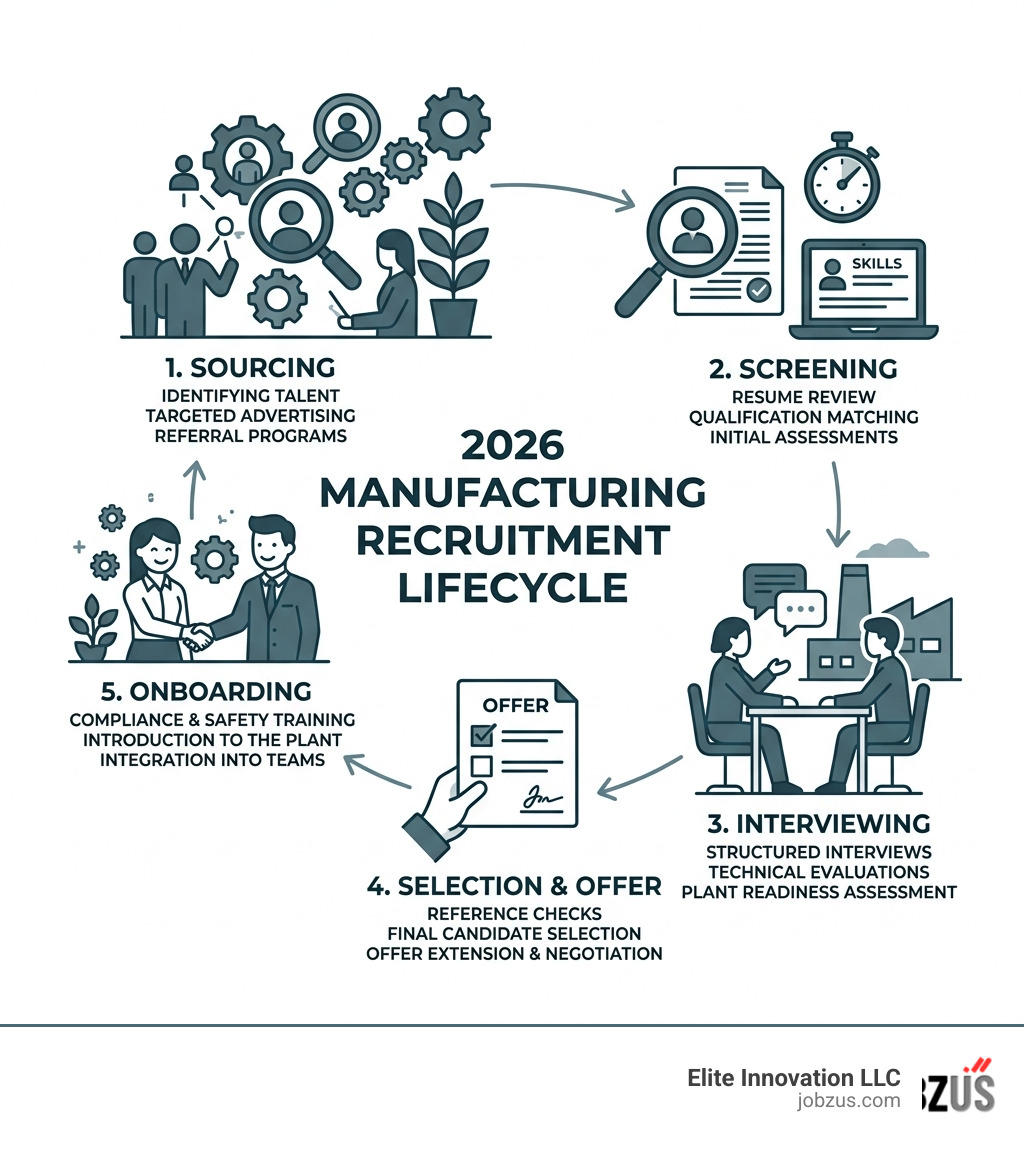
Easy industrial manufacturing recruitment glossary:
Navigating the Challenges of Industrial Manufacturing Recruitment in 2026
As we move through 2026, the landscape of industrial manufacturing recruitment has shifted from a simple search for “hands” to a complex hunt for specialized brains and steady nerves. The modern production floor is a marvel of technology, but it requires a specific type of professional to keep the gears turning.
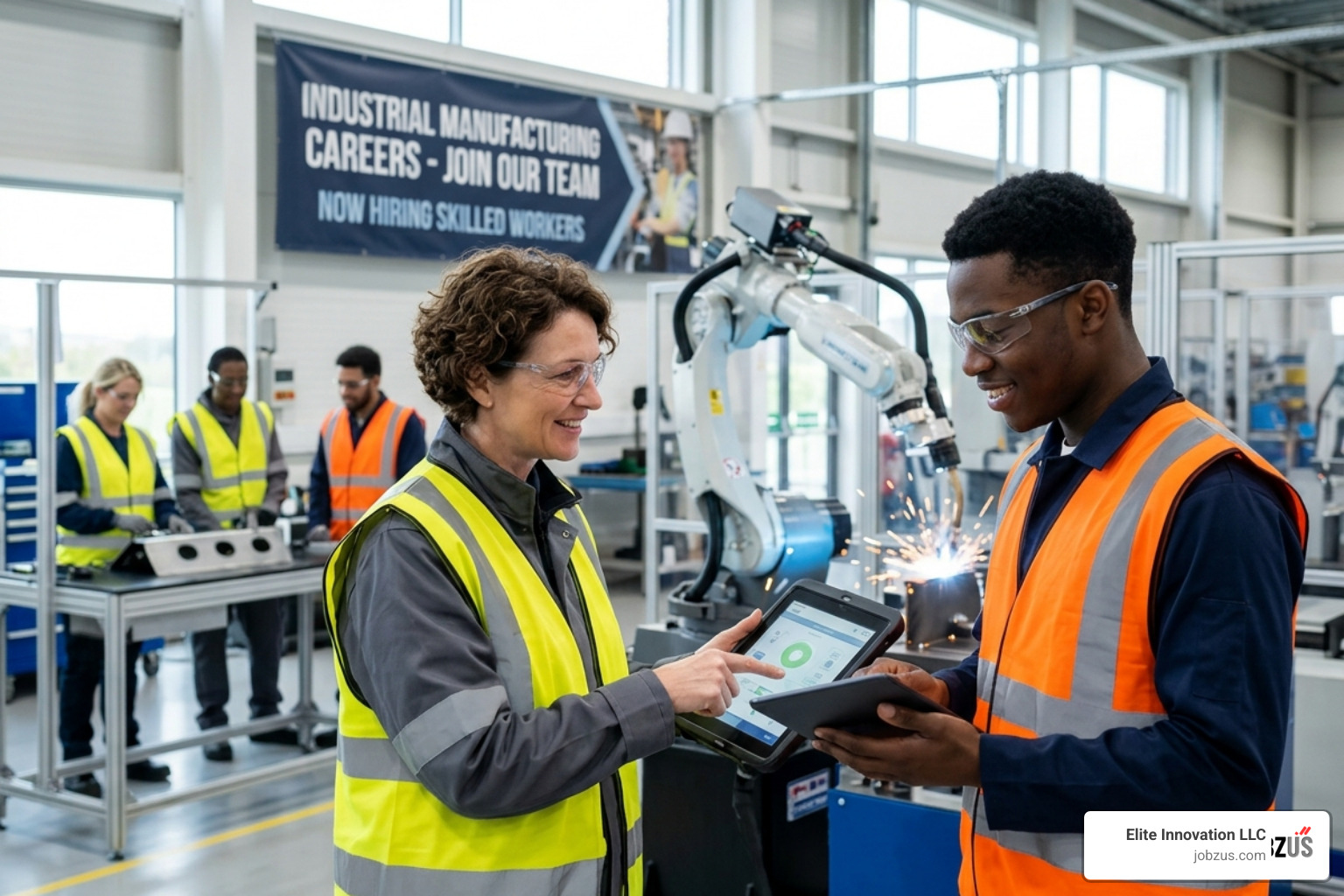
The primary hurdle we face today is a multi-front battle. First, there is the undeniable “Silver Tsunami”—the mass retirement of veteran workers who carry decades of institutional knowledge in their heads. When these experts clock out for the last time, they often leave behind a vacuum that isn’t easily filled by a simple job posting.
Second, the digital transformation of the industry means that even traditional roles now require a baseline of digital literacy. Whether it is interacting with an ERP system or troubleshooting a robotic arm, the “industrial” part of the job is now inseparable from the “technology” part. If you are struggling to keep up with these changes, learning how to find industrial technology jobs near you today can provide insights into where the talent is currently migrating.
Furthermore, many industrial facilities are located in remote areas, far from major urban hubs. This geographic isolation makes it difficult to attract younger talent who may prefer the amenities of city life. To thrive, we must rethink how we market these roles, emphasizing the high-tech nature of the work and the stability it offers.
Addressing the Technical Skills Shortage
The technical skills gap is perhaps the most discussed topic in industrial manufacturing recruitment. We are no longer just looking for people who can swing a hammer; we need individuals with “technical fluency.” This means understanding how mechanical systems interface with software.
To bridge this gap, proactive manufacturers are engaging in heavy STEM outreach and upskilling programs. Instead of waiting for the perfect candidate to appear, we are increasingly looking at where industrial engineering grads actually work anyway to understand how to divert that talent into our plants. By partnering with local vocational schools and universities, we can create a pipeline that starts long before a student even graduates.
Overcoming Geographic and Industry-Specific Barriers
Location shouldn’t be a dealbreaker, but in 2026, it often is. To combat this, talent mobility has become a cornerstone of our strategy. This involves more than just offering a relocation check; it’s about selling a lifestyle and a career path.
Regional labor markets vary wildly. For instance, recruiting in the New York NY area looks very different from sourcing talent in Muscat, Oman, or Karachi. In the Middle East—specifically in Qatar and Saudi Arabia—there is a high demand for specialized engineers who can navigate large-scale infrastructure projects. Meanwhile, in Malaysia and the broader USA, the focus often shifts toward automation and lean manufacturing expertise. Understanding these regional nuances allows us to tailor our recruitment packages to what local (or mobile) talent actually values.
Building a High-Performance Workforce: From Skilled Trades to Executive Leadership
A plant is a living organism. It needs a “brain” (the C-suite and plant managers) and “muscles” (the CNC machinists, welders, and mechanics). If either part is weak, the whole system fails.
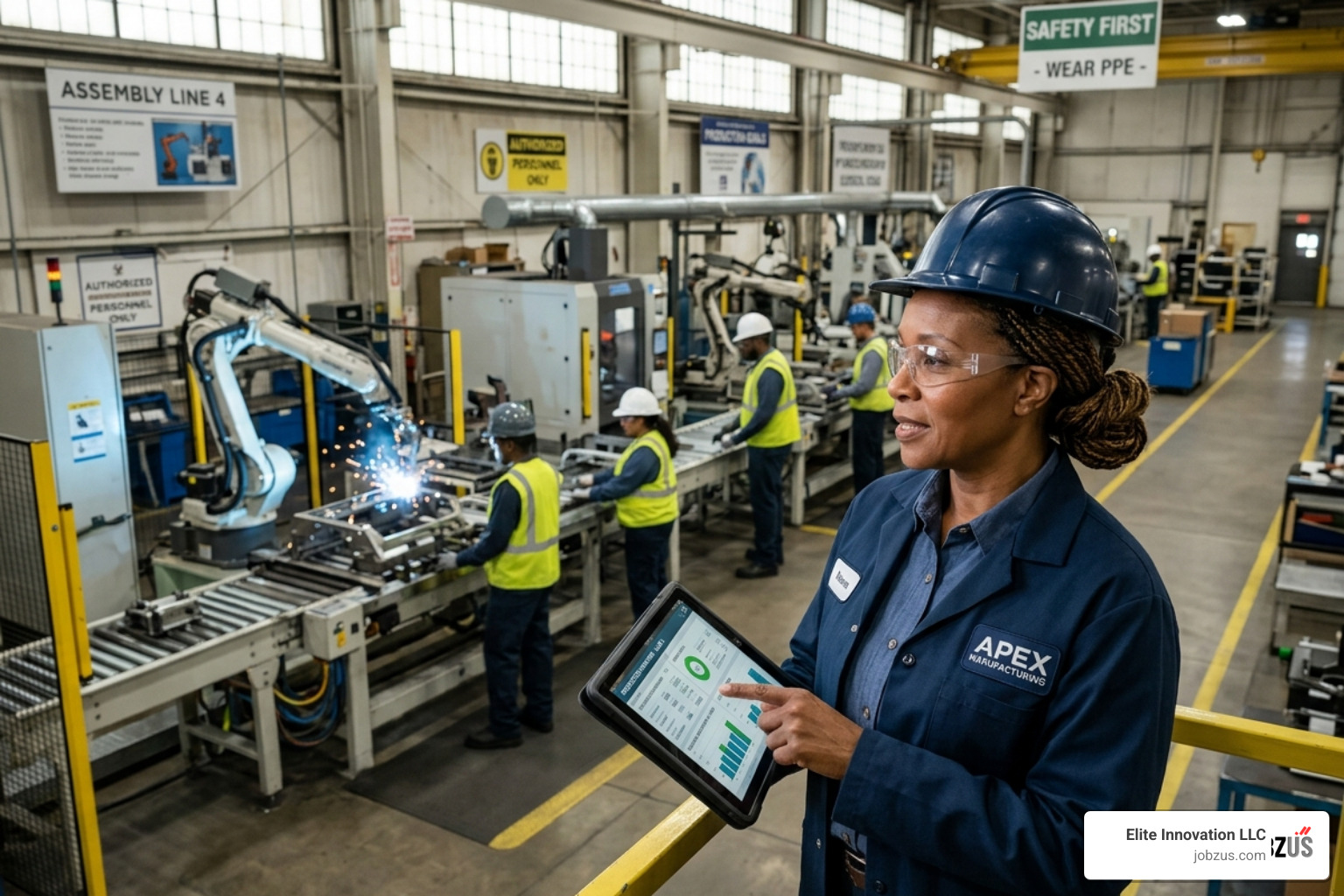
Effective industrial manufacturing recruitment covers the entire spectrum. At the executive level, we look for visionary leaders who understand not just the “how” of production, but the “why” of global competitiveness. At the shop floor level, we need the precision of a master welder or the analytical mind of a maintenance mechanic who can hear a bearing failing from across the room. For those just starting their journey, finding the best graduate manufacturing engineer jobs for new grads is the first step toward becoming the future leaders of the industry.
Identifying Specialized Skills for Industrial Manufacturing Recruitment
When we talk about specialized skills, we are looking for more than just a list of keywords on a resume. We need verified expertise in:
- PLC Programming & Automation: The ability to speak the language of the machines.
- Mechanical & Electrical Controls: Ensuring the power stays on and the parts stay moving.
- Quality Assurance (QA): Maintaining the standards that keep customers coming back.
- EHS Compliance: Keeping our people safe and our operations within legal bounds.
Screening for Safety, Plant Readiness, and Cultural Fit
You can teach someone how to operate a specific machine, but it is much harder to teach a “safety-first” mindset. In our recruitment process, we prioritize candidates who demonstrate a deep understanding of OSHA standards and process safety management.
Plant readiness is about more than just showing up on time. It’s about the “soft skills” of the hard world—behavioral traits like situational awareness and the ability to work in high-heat or high-noise environments without losing focus. If you’ve recently shifted your career focus, perhaps after realizing you graduated in industrial design and now you need a job, you’ll find that the transition to the industrial floor requires a significant adjustment in how you view safety and teamwork.
Choosing the Right Staffing Model for Your Production Goals
Not every vacancy requires the same approach. Depending on whether you’re launching a new line or replacing a retiring supervisor, your staffing model should change.
| Model | Best For | Key Benefit |
|---|---|---|
| Retained Search | Executive & C-Suite | Exclusive focus and high discretion |
| Contingency | Mid-level & Professional | No fee unless a hire is made |
| Contract Staffing | Projects & Peak Seasons | Maximum flexibility and speed |
| Temp-to-Hire | Entry-level & Skilled Trades | “Try before you buy” for cultural fit |
Leveraging RPO and MSP for Scalable Industrial Manufacturing Recruitment
For large-scale operations in places like Saudi Arabia or the USA, individual hiring can become overwhelming. This is where Recruitment Process Outsourcing (RPO) and Managed Service Providers (MSP) come in.
RPO allows us to hand over the entire “engine” of recruitment to experts who live and breathe talent acquisition. They handle everything from sourcing to onboarding, allowing your HR team to focus on employee engagement. MSPs, on the other hand, act as a single point of contact for all your staffing suppliers, ensuring you get the best rates and the highest quality workers across all your vendors. This level of workforce agility is essential for modern manufacturers who need to scale up or down based on global market demands.
Why Specialized Recruiters Outperform General Agencies
General agencies are like Swiss Army knives—useful for many things, but not always the best tool for a specific job. Specialized manufacturing recruiters bring “technical mastery” to the table. They know the difference between a manual lathe and a 5-axis CNC machine. They understand why a Process Engineer is not the same thing as a Manufacturing Engineer.
Specialized firms maintain deep networks of passive candidates—people who aren’t looking at job boards but might move for the right opportunity. By tapping into a network of over 375,000 skilled labor candidates, these experts can reduce the time-to-fill for critical roles significantly. If you are a candidate, finding the best manufacturing jobs near you right now is much easier when you work with someone who actually speaks your language.
Strategies to Attract and Retain Top Manufacturing Talent
In 2026, the power has shifted toward the candidate. To win the talent war, we have to be the kind of employer people want to work for, not just the one that pays the bills.
Employer branding is no longer optional. Your plant needs to tell a story of innovation, safety, and community. This includes diverse and inclusive (DE&I) initiatives that welcome workers from all backgrounds, ensuring that our workforce reflects the global markets we serve, from New York to Malaysia.
Reducing Time-to-Fill for Critical Industrial Positions
In the industrial world, every day a position is vacant is a day of lost production. To move faster, we utilize:
- Centralized Recruiting Centers: Streamlining the process so we can identify and screen candidates in as little as 24-48 hours.
- Automated Screening: Using AI to filter for “must-have” certifications (like OSHA 10) so humans only talk to the most qualified people.
- Talent Pipelines: Maintaining “warm” relationships with candidates so we have someone ready to go the moment a vacancy opens.
Utilizing Technology and Data in Talent Acquisition
Data is the new oil, even in HR. By using predictive analytics, we can forecast when we might see a spike in turnover or which departments will need more staff due to upcoming project phases. Applicant Tracking Systems (ATS) have evolved from simple databases into sophisticated AI-driven platforms that help us match the right skills to the right roles with surgical precision.
This technology also improves the candidate experience. Digital onboarding allows a new hire in Oman or Qatar to complete their paperwork and safety training before they even step foot on the plant floor, making their first day about meeting the team, not filling out forms.
Frequently Asked Questions about Industrial Manufacturing Recruitment
How do you evaluate candidates for plant floor readiness?
We look beyond the resume. We use behavioral interviewing to ask about specific “near-miss” safety incidents they’ve witnessed and how they handled them. We also verify hands-on experience through technical testing or references that can speak to their performance in high-pressure production environments.
What is the difference between RPO and traditional staffing?
Traditional staffing is usually reactive—you have a hole, they find a person to fill it. RPO (Recruitment Process Outsourcing) is a strategic partnership where the provider takes over the entire recruitment function, focusing on long-term goals, employer branding, and process improvement to reduce costs and improve hire quality over time.
How can manufacturers attract younger workers to industrial roles?
By highlighting the “cool factor” of modern manufacturing. Today’s plants are filled with robotics, 3D printing, and high-end software. We also emphasize career stability and the fact that many of these roles offer a path to high-paying leadership positions without the need for a traditional four-year degree.
Conclusion
At Elite Innovation LLC, we believe that the strength of any industrial operation lies in its people. From the bustling ports of Muscat to the high-tech hubs of the USA, industrial manufacturing recruitment is the foundation of operational excellence.
By moving away from generalist hiring and embracing specialized, data-driven strategies, we don’t just fill seats—we build high-performance teams. Whether you are looking to optimize your workforce or seeking your next career move, the future of industry is bright for those who prioritize talent.
Are you ready to take the next step in your industrial career? Explore specialized industrial career opportunities and join the ranks of the professionals driving the world forward.
